Clean Your Heat Pump Water Heater Filter (How Often + How)
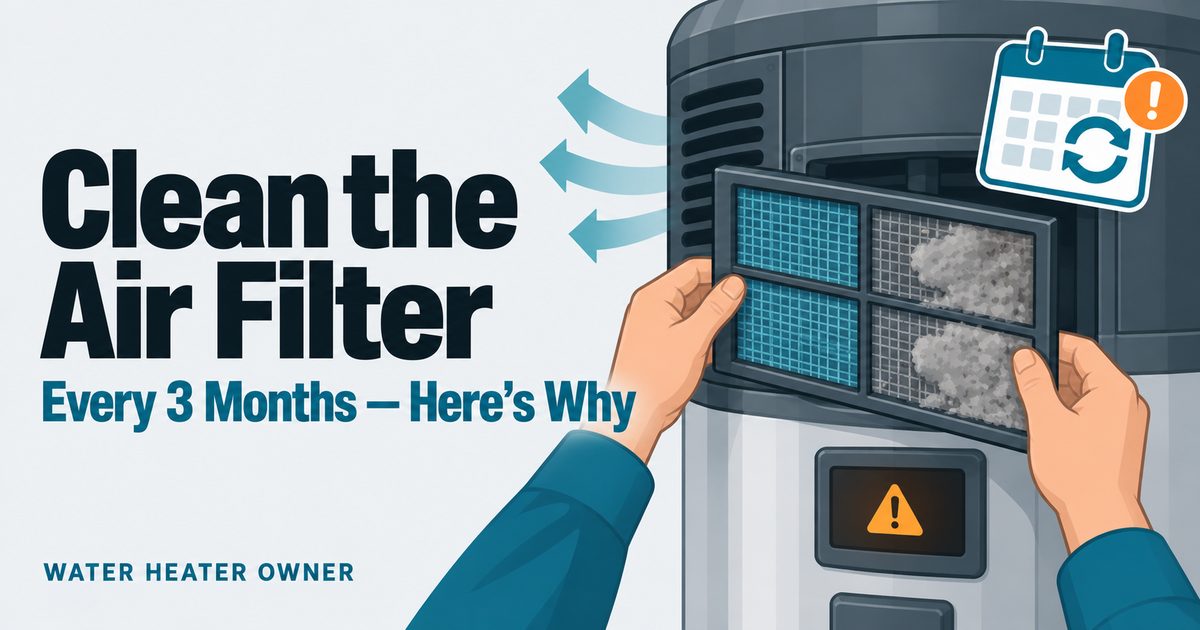
Clean your heat pump water heater’s air filter when the unit asks — T131 on a Rheem, SF on the 2019 A.O. Smith Voltex, F74 on the new GE GeoSpring — and check it between alerts: a common rule of thumb is every three months, sooner in a dusty garage. A clogged filter chokes airflow, so the unit makes less hot water and can run up your bill. The job takes minutes, but the method depends on the brand: Rheem’s filter is washed with mild detergent; A.O. Smith’s is vacuumed.
A heat pump water heater is, at heart, a small air conditioner running in reverse — air is the fuel, and the filter is the cheapest, most neglected part of the whole machine.
How often to clean it
The equipment and the calendar give you two different triggers; use both:
- Rheem ties it to the unit. The Gen V manual recommends cleaning the filter when the T131 “Clean Filter Reminder” appears on the display (AP23657 Use & Care, pp. 28, 33). A common rule of thumb among owners is to check it about every three months as well.
- A.O. Smith’s schedule depends on the generation. The 2012 Voltex manual asks for a monthly visual inspection of the filter (318257-002, p. 17), and the State/A.O. Smith PHPT service handbook calls for the same monthly look (321547-000, p. 11). The 2019 Voltex watches the heat pump’s operation and shows SF when the filter needs cleaning; its maintenance schedule puts filter cleaning at six months and at least annually after that (100323093, pp. 3, 30).
My take: put a quarterly reminder on your phone and glance at the filter monthly when you walk past. Where the unit lives decides everything — a hybrid in a woodworking garage or next to the dryer will mat a filter in weeks; one in a clean utility closet cruises to the quarterly cleaning easily.
Why a dirty filter matters
This is the part almost nobody connects. Choked airflow ripples through everything the unit does:
- Less hot water. With less air across the evaporator, the heat pump extracts less heat per hour. Recovery slows down, and the “we ran out of hot water again” complaints start.
- A higher bill — often silently. This is the sneaky one. On the Rheem, the manual’s low-airflow code, T005, carries the consequence “heating source defaults to elements due to low airflow” (AP23657, p. 32). When the heat pump can’t breathe, the unit quietly falls back to its resistance elements — the heating you bought a hybrid to avoid. Nothing looks broken; your bill just climbs. More on that pattern in why your heat pump water heater uses so much electricity.
- Alarms. Rheem’s T131 filter reminder, plus compressor-protection codes whose manual checklist includes “confirm filter screen is clean” — right after checking that the fan runs. On the 2019 Voltex it’s SF; on the current GE GeoSpring it’s F74, “dirty filter” (per GE’s support page). A dirty filter is also a classic reason the unit starts beeping at you.
How to clean it, step by step
Where it sits and how it comes out depends on the brand. Rheem’s Gen V filter lifts out of a slot on top, no tools, and is washable. The 2019 Voltex’s slides out of the top cover by two tabs. The 2012 Voltex and PHPT units secure the filter panel with a screw — and A.O. Smith says to vacuum its filters, not wash them. A few minutes start to finish:
- Put the unit in a safe state. Rheem says switch to Electric mode or Off before pulling the filter (AP23657, p. 33); A.O. Smith says Standby and power off at the breaker on the 2012 Voltex (318257-002, p. 17), and power off at the breaker on the 2019 (100323093, p. 30). Follow your manual — presumably so the fan isn’t pulling unfiltered air while the slot is open.
- Slide the filter out of the top of the unit (on the 2012 Voltex and PHPT, loosen the screw holding the filter panel first) — this is exactly why the installation specs demand clearance above the heat pump.
- Clean it the way your manual says. Rheem’s procedure is washing with mild detergent and water (p. 33). A.O. Smith’s manuals, 2012 and 2019, say to use a vacuum with a hose attachment — don’t wet those filters unless your manual says you can.
- If you washed it, let it dry completely. Rheem says dry it before it goes back in; a damp filter in moving air is a dust magnet and can smell musty.
- Reseat it and restore your setting. Put it back in its slot (on A.O. Smith units, by its tabs or with the screw), switch back to your usual mode or restore power, and clear the reminder from the panel — on a Rheem, Current Alarms → Clear Alarm. The A.O. Smith units run a self-diagnostic of about 8 minutes when power comes back.
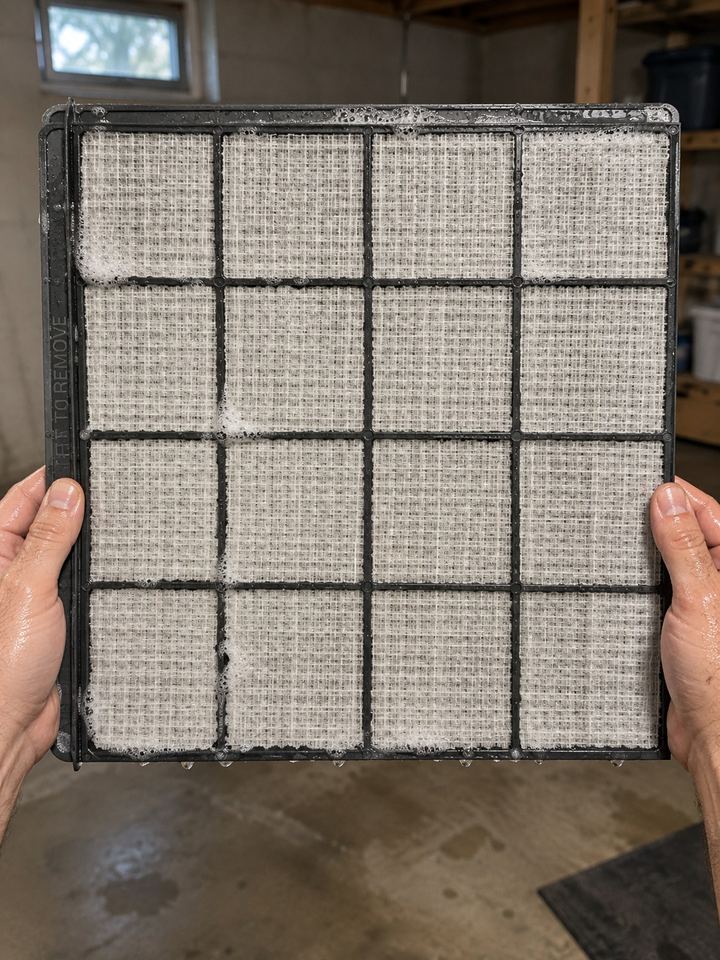
Mark the date on the jacket with a marker — future you will want to know when it was last done.
By brand: where yours is and what the manual says
- Rheem hybrid (Gen V): filter slot on top; T131 is the reminder code; remove, wash with mild detergent, dry, reinstall (AP23657, pp. 28, 33). Keep 6” clear above the unit. The replacement filter is part AP20142 (Replacement Parts, p. 39).
- A.O. Smith Voltex (2012): monthly visual inspection; Standby and cut power, loosen the screw on the filter panel, then remove the filter and clean it with a vacuum hose — or replace it (318257-002, p. 17). Heads-up: the unit runs a self-diagnostic of about 8 minutes when power is restored, so don’t panic when it doesn’t heat instantly.
- A.O. Smith Voltex (2019): the display shows SF when the filter needs cleaning; cut power at the breaker, slide the filter out of the top cover by its two tabs, and vacuum it — or replace it (100323093, p. 30). The maintenance schedule calls for filter cleaning at six months and at least annually after that.
- State / A.O. Smith PHPT: same monthly inspection (321547-000, p. 11). The service handbook also covers what happens when filter care is skipped too long: a dirty evaporator — a fussier job needing an A/C coil cleaner safe for ABS plastics, applied only from the air-inlet side, never sprayed at the fan motor (p. 35). That’s the chore a clean filter exists to prevent; a visibly matted coil is technician territory in my book.
- GE GeoSpring (2025+): the display tells you — F74 means dirty filter, per GE’s support page; clean it per the owner’s manual. The older 2012–2016 GeoSpring has a filter light instead.
When cleaning isn’t enough
A filter alert should clear after a proper cleaning. When the trouble doesn’t, the filter may have been the symptom, not the disease — and what that means depends on the brand:
- F74 keeps coming back (GeoSpring 2025+): GE’s support guidance says that if the fault repeats after cleaning, the likely cause is a refrigerant leak — a service call, full stop. The sealed system is not owner territory.
- Rheem airflow/compressor codes with a clean filter: the manual’s checklist points at the fan and at signs of refrigerant leakage — an oily residue around the compressor is the tell it mentions (AP23657, p. 32). That inspection is the technician’s: the compressor sits inside the unit, and Rheem warns its wiring terminals can arc and release flammable refrigerant and oil. If the compressor isn’t running or there are signs of leakage, the manual says the unit will need to be replaced, because Rheem doesn’t service sealed-system parts. Same verdict: technician.
Either way, decode what the unit is telling you before you pay for a visit — the error codes guide by brand covers the full tables. And the filter isn’t the only recurring job: the manuals also ask for a yearly T&P valve test, condensate drain care (Rheem: a cup of bleach down the condensate drain at least once a year — more in the condensate drain guide), draining or flushing sediment, and, on sacrificial-anode models, inspecting the anode — covered in the rotten egg smell and anode guide.
FAQ
Can I wash the filter, or do I need to replace it? Depends on the brand. Rheem says wash it with mild detergent and water; A.O. Smith says vacuum it or replace it. Replace it if the mesh is torn, crushed, or won’t come clean; your manual’s parts list has the part number (AP20142 on the Rheem Gen V).
What if my unit doesn’t seem to have a filter? Check the manual before assuming — on the hybrids covered here it’s a panel on top of the unit (held by a screw on the 2012 Voltex and PHPT) that’s easy to miss. If it’s genuinely missing, get a replacement before running the unit long-term: A.O. Smith’s service handbook says proper filter care should keep the evaporator from getting dirty, and a matted evaporator coil is a much harder cleaning job than a filter rinse.
I cleaned the filter but the alarm won’t clear. Now what? Make sure the filter is fully seated and clear the alert from the control panel — on a Rheem, T131 is a maintenance reminder you clear under Current Alarms. What a returning alert means depends on the brand: on the 2025+ GeoSpring, GE’s support page says a repeating F74 after cleaning points to a probable refrigerant leak — a service call. On a Rheem, a reminder isn’t a diagnosis; if you’re also seeing compressor or airflow codes (A004–A006, T005/T006), the manual’s checklist includes an inspection for oily residue around the compressor, which is a technician’s job — and a leak means a technician, not another cleaning.

Dan Mercer — Dan Mercer is the pen name of Water Heater Owner’s editor. I’m not a licensed plumber or electrician, and I don’t sell or install water heaters. Every guide here starts from the manufacturers’ manuals and technical bulletins, is cross-checked against what owners consistently report, and says which is which — including what you can safely check yourself and when it’s a job for a licensed plumber or electrician.