Heat Pump Water Heater Error Codes by Brand (Cheat Sheet)
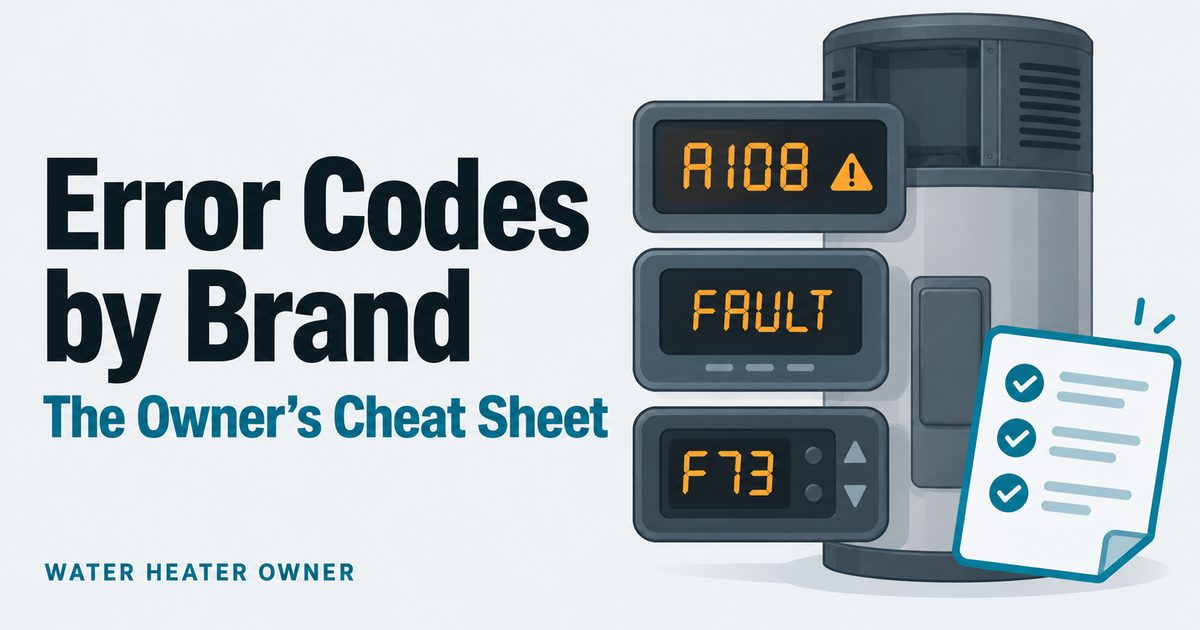
Hybrid water heater error codes are brand-specific — and often generation-specific. Rheem uses “A” and “T” codes (A108 = condensate blocked). A.O. Smith’s Voltex shows text messages on the 2012 generation and short codes (E20, Edr, SF…) on the 2019 generation; its current hybrid shows three-digit numbers (001–086). GE GeoSpring uses F-codes — and there are two different GeoSpring generations with different codes and different support lines. So: identify your brand and year, find the code, then decide whether it’s a DIY fix or a service call.
One thing before the tables: no page on the internet — including this one — lists every code for every model. What I’ve done instead is put the codes owners actually search for in one place, per brand, with what to check first and an honest DIY-or-technician call for each. For anything not listed here, your model’s manual is the real source, and I’ll tell you where to look.
First: find your brand and generation
This sounds obvious, but it’s the step the generic “error code” sites skip, and it’s why their advice so often doesn’t match your display.
- The brand is on the front jacket — Rheem, Ruud, A.O. Smith, State, GE. The model and serial number are on the rating plate (a sticker, usually on the front or side of the tank). Take a photo of it now; you’ll need it for any support call.
- The year matters more than you’d think. A 2013 unit and a 2025 unit from the “same” brand can be entirely different machines with different code families. GE GeoSpring is the extreme case — more on that below — but it’s also true for A.O. Smith’s Voltex line.
- Where the code shows up differs too. Rheem’s Gen V units display alarms on the front panel (the manual also notes that its leak-detection alerts reach the EcoNet app). If your heater is beeping but you can’t find a code, the alarm menu is usually a few button presses away — Rheem’s manual has you press NEXT to “Current Alarm,” then the down arrow to scroll through active alarms.
Rheem: the A-codes and T-codes
Rheem’s hybrid line (this covers the Gen V “Universal Connect” 208–240 V models; codes come from Rheem’s 2024 use & care manual AP23657) uses A- and T-codes — and don’t read the letter as a severity scale: T131 is a filter reminder, but T005 and T006 are compressor shutdowns that switch the heater to its elements. (Ruud is a sister brand in the same company; I haven’t checked a Ruud manual, so confirm your codes against yours.) These are the ones owners hit most:
| Code | What it means | What to check first | DIY or tech? |
|---|---|---|---|
| A108 | Condensate line blocked — unit defaults to the electric elements | The condensate line and drain pan under the top cover: find and clear the clog | DIY first. Full walkthrough: Rheem A108 explained |
| A107 | Water detected on the floor — the manual’s cause is water in the drain pan, picked up by the leak rope sensor (a different sensor from A108’s) | An actual leak first; if there’s none, a wet or failed rope sensor | DIY diagnosis. Dry or replace the sensor; if the code persists with a new sensor, the manual points to the board (technician). Holding “Clear Alarm” 5 seconds overrides it for 24 h |
| T131 | Clean-filter reminder | The air filter — set the unit to Electric or OFF, then wash it with mild detergent and water | DIY. Step-by-step: cleaning the air filter |
| A200 | High water temp — the ECO (high-limit) has tripped and disabled the heater | Nothing yourself. The manual’s wording is “Call Tech Service,” and it says the cause of the overheat must be investigated by a qualified service technician before the heater goes back in service | Technician. The ECO is a safety device; if it tripped, something made it trip |
A few more worth knowing about, briefly: A008 is dry-fire protection — the tank isn’t full or there’s air in it, and the heater is disabled (fill the tank and purge the air by running a hot tap; the manual calls it generally an installation issue). A101–A106 are temperature sensor failures: on A101, A102, A105, and A106 the unit keeps heating on the electric elements, but A103/A104 (the tank sensors) disable the heater — either way, a sensor fault is a technician visit. And most compressor-related codes (A004–A006 territory) carry the same fine print: “heating source defaults to elements.” That’s Rheem-speak for “your hybrid is now running as a plain electric heater” — the unit still makes hot water, but your bill quietly goes up until the fault is fixed.
If your Rheem is beeping without an obvious code, that’s its own diagnostic path — I’ve broken it down in Rheem hybrid water heater beeping.
A.O. Smith Voltex: text messages or short codes, depending on the year
The Voltex changed code families between generations, and that’s where most of the confusion starts. The 2012 generation (60 and 80 gallons, manual 318257-002) shows plain-text messages:
| Message | What it means | DIY or tech? |
|---|---|---|
| UPPER / LOWER ELEMENT CONNECT FAULT | A heating element isn’t working | Technician. The manual’s fix is checking the element’s wiring connection, then replacing the element: 240 V work behind an access cover, and a swap means draining the tank |
| HEAT PUMP CONNECT FAULT | The compressor isn’t running | Technician |
| …TEMP SENSOR SHORT OR OPEN / COIL TEMP SENSOR FAULT | A temperature sensor failed | Technician |
| LOW WATER LEVEL ALARM | The tank isn’t completely full | DIY — open every hot tap until water runs air-free |
| ELECTRONIC POWER ANODE ERROR #0–9 | The powered anode isn’t operating correctly | Technician (the only message with a number in it) |
The 2019 generation (50, 66, and 80 gallons, manual 100323093) uses short codes instead: E20/E21 and E30/E31 for the upper and lower tank temperature sensors, E10/E11, E40/E41, and E50/E51 for the heat-pump sensors, Edr for a tank that isn’t full, EPL for low supply voltage, EDH for a compressor running too hot, EUC/ELC for the upper/lower element, SF for a dirty air filter — plus ICE and HPO, which are normal operating states, not faults. That manual opens its code table with an electric-shock warning: disconnect power before servicing, and don’t touch the wiring.
A.O. Smith’s current hybrid (manual 100379659, March 2025) switched again, to three-digit numbers from 001 to 086: the main owner-side ones are 001 (tank not full — breaker off, fill it and bleed the air through a hot tap), 080 (dirty air filter — breaker off, then vacuum it) and 081 (condensate — check the unit is level and the drain line is clear), while its sensor, element and compressor codes go to a qualified person or A.O. Smith’s hotline.
None of the three A.O. Smith manuals lists an E01 or E02. If that’s what your display shows, confirm the model on the rating plate and pull that model’s own manual.
The full breakdown for all three generations — elements, sensors, the low-water alarm you can clear yourself, and the anode — is in the A.O. Smith Voltex error codes guide.
GE GeoSpring: which one do you have?
This is the brand where “check your year” isn’t pedantry — it changes everything: the codes, the manual, and who picks up the phone.
GeoSpring 2012–2016 (discontinued). GE stopped making these in December 2016, which left owners with an orphan brand. Service and support were taken over by Bradford White (1-888-443-4394 — the old manual prints the same number as GE’s 1-888-4GE-HEWH line; verify the current number on Bradford White’s site before calling). The old generation uses short F-codes: F-3 is compressor failure, F-4 fan failure, F-8 the ambient temperature sensor, F-9/F-10 lower/upper heating element failure, and F-11 a dry-tank fault; F-A through F-F are heat-pump system faults. The honest summary from the old troubleshooting sheet: nearly every code on this unit resolves to “call service.” The exceptions you can act on yourself: a beeping F11 on first startup means the tank was never filled (fill it completely before powering on — the warranty doesn’t cover damage from running with an empty or partly empty tank), and “bAd linE” means the unit isn’t getting the 240 VAC it expects: turn the power off at the breaker and have the installer verify the electrical supply.
GE Profile GEOSPRING 2025+ (relaunched). GE brought the name back in 2025 as a new machine with a new code family — F10 through F96 — and its own support line: GE Appliances, 1-800-943-8186 (printed in its owner’s manual; again, verify on geappliances.com). Per that manual (GE 49-6000330), several of these are owner-fixable: F73 is a clogged condensate drain port (clear the obstruction — same pain as Rheem’s A108), F74 is a dirty air filter (clean it; if the code comes back after cleaning, GE flags a possible refrigerant leak — that’s service), F75 is a dry-tank fault (confirm the tank is full), and F78/F81 relate to the leak sensor and its battery.
If a mill-style guide shows you one merged “GeoSpring code list,” close the tab. Mixing the two generations is an easy mistake to make, and it sends people to a support line that can’t help them.
State, and the rest of the A.O. Smith family
A.O. Smith and State’s early hybrid platform — the PHPT-60/80, covered by a 2011 A.O. Smith service handbook — uses the same plain-text fault messages as the 2012 Voltex: “Upper Element Connect Fault,” “Heat Pump High Pressure Fault,” and so on. The handbook shows the method a technician uses on each one: check the connection, test the component with a meter against that model’s spec, and only then suspect the control board — and its cover says service should only be performed by a qualified service technician. The specific numbers in that handbook (element resistance, pressure-switch thresholds) belong to that platform only — don’t carry them over to a Rheem or to the 2019 Voltex.
For any brand not covered here — Bradford White, Stiebel Eltron, rebadged units — the pattern holds: rating plate → model number → that model’s manual → the brand’s own support line. A code without the right manual is just a guess.
How to reset a hybrid water heater (and when a reset isn’t the fix)
There’s no universal reset. Rheem clears alarms from the panel (Setting Menu → Current Alarms → the Clear Alarm button); A.O. Smith’s PHPT handbook clears certain faults by turning the power off at the breaker for ten seconds; and the 2019 Voltex manual has its own power-cycling procedure. Two honest caveats:
- A reset clears the display, not the problem. If the condensate line is still clogged, A108 comes right back. If a sensor has failed, the code returns after the next cycle. Codes that reappear after a reset are a strong sign the fault is real.
- Some resets are physical, and they’re a flag. Rheem’s A200 means the ECO (the high-limit) has tripped. The manual does describe its red reset button in the upper cavity — but it says the cause of the high temperature must be investigated by a qualified service technician, and corrected, before the heater goes back in service. On A200, the reset belongs to the technician, after the diagnosis.
My rule of thumb: for ordinary alarms, clear once, note the code and time, and if it comes back, work the code — don’t keep clearing it. For a safety lockout like A200 or a tripped ECO, don’t reset it yourself at all.
FAQ
How do I clear an error code on a heat pump water heater? Fix the condition, then clear it the way your manual says — on a Rheem, the Clear Alarm button in the Current Alarms menu; on some A.O. Smith platforms, a power cycle at the breaker. Rheem’s bulletins for A108 list clearing the alarm as a step; nothing in them says it clears itself. ECO/high-limit trips need a physical reset, which the manuals tie to a qualified technician finding the cause first. A code that keeps returning means the underlying fault is still there.
My brand isn’t listed — where do I find my codes? On the rating plate, get the exact model number, then download that model’s use & care manual from the manufacturer’s site (they’re free PDFs). The troubleshooting table near the back is the authoritative list for your unit — more reliable than any aggregator site, including this one.
Does an error code always mean a repair bill? No. Several of the most common codes are owner-fixable: clogged condensate lines (Rheem A108; F73 on the 2025+ GeoSpring, per GE’s support page), dirty filters (Rheem T131; the 2019 Voltex’s SF; F74 on the 2025+ GeoSpring), and low-water alarms after installation (purge the air). What I’d leave to a qualified technician: anything involving the compressor, refrigerant, sensors, the control board, or a tripped high-limit — on a 208–240 V sealed-system appliance, that’s not the place to learn by doing.
Who supports the GE GeoSpring now? Depends on the generation. The discontinued 2012–2016 units are supported through Bradford White (1-888-443-4394 — the same number the old manual prints as GE’s line); the relaunched 2025+ GE Profile GEOSPRING is supported by GE Appliances (1-800-943-8186). Verify both numbers on the companies’ official sites before calling — support arrangements change.

Dan Mercer — Dan Mercer is the pen name of Water Heater Owner’s editor. I’m not a licensed plumber or electrician, and I don’t sell or install water heaters. Every guide here starts from the manufacturers’ manuals and technical bulletins, is cross-checked against what owners consistently report, and says which is which — including what you can safely check yourself and when it’s a job for a licensed plumber or electrician.