A.O. Smith Voltex Error Codes: What the Display Means
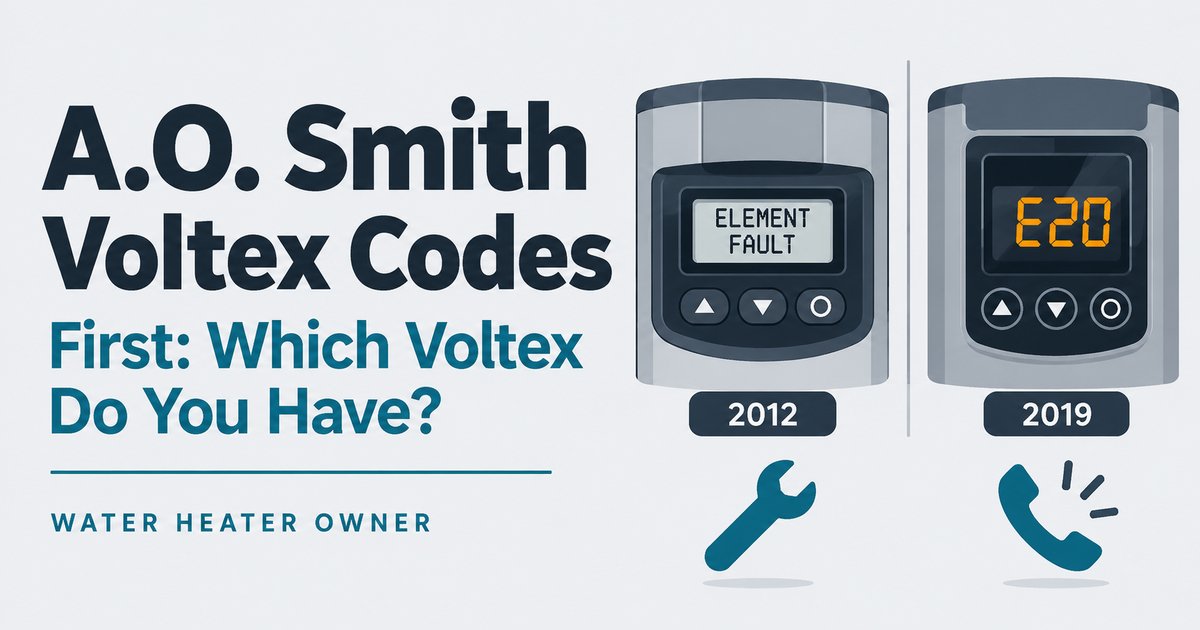
A.O. Smith Voltex error codes depend on the generation. The 2012 Voltex shows text messages — “LOWER ELEMENT CONNECT FAULT,” “HEAT PUMP CONNECT FAULT,” “LOW WATER LEVEL ALARM.” The 2019 Voltex shows short codes like E20, Edr, EPL or SF — plus ICE and HPO, which are normal states, not faults. A.O. Smith’s current hybrid (manual dated March 2025) shows three-digit numbers, 001 through 086. None of the three manuals lists an E01 or E02. A few you can fix yourself — a tank that isn’t full, a dirty filter — the rest are a qualified-service call.
First: which Voltex do you have?
If you’ve been typing “ao smith voltex error code e02” into Google and nothing matches what’s on your display, there’s a reason: the code family depends on the generation, and none of A.O. Smith’s three hybrid manuals lists an E01 or E02.
- 2012 generation (60 and 80 gallons, manual 318257-002): the display
spells the fault out in words. The only message with a digit in it is
ELECTRONIC POWER ANODE ERROR #0–9. - 2019 generation (50, 66, and 80 gallons, manual 100323093, dated September 2019): the display shows short codes — E10 through E60, Edr, EPL, EDH, SF and others — plus ICE and HPO, which aren’t faults at all.
- Current generation (50, 66, and 80 gallons, manual 100379659, dated March 2025): a fault shows as a three-digit number with a flashing alert icon, and the control panel has its own buttons for each mode plus Wi-Fi and Bluetooth.
The model number is on the data plate (on the 2012 model, next to the upper element door). If your unit doesn’t match any of the three manuals, pull its own manual from A.O. Smith’s site before trusting any code list, including this one.
The pattern across almost every fault below is the same, and it’s worth internalizing: loose connection first, component test second, control board last. A.O. Smith’s own service handbook for the related PHPT platform (same text-message family as the 2012 Voltex) lays out that exact sequence for its technicians — check the wiring, meter the component against spec, and only then suspect the board. The specific test numbers belong to each platform, so I won’t transplant them here; the order is what saves you money.
The 2012 Voltex, message by message
Everything in this section comes from the 2012 manual (318257-002). If your display shows short codes instead, skip to the 2019 codes.
Element faults: UPPER / LOWER ELEMENT CONNECT FAULT
What it means: one of the two electric heating elements isn’t working. The 2012 Voltex has a 4,500 W upper element and a 2,000 W lower element backing up the heat pump.
What the manual says to do: turn off power at the breaker and check for a loose wire connection at the element. If the fault persists after that, the element itself has failed and needs replacing.
DIY or tech? Technician. The element’s wiring connection sits behind an access cover on a 240 V circuit, and replacing the element also means draining the tank, so both the connection check and the swap are work for a qualified technician (the manual’s own warning: disconnect power before servicing). Your part is noting the exact message for the call. One hard rule from the 2012 manual either way: never put an element larger than 2,000 W in the lower position. It damages the unit and voids the warranty — that slot is sized for the hybrid’s design, not for “more power.” (The 2019 generation is different: its manual sends you to the data plate for the correct wattage and voltage, and its parts list shows a 4,500 W element — don’t carry the 2012 split over to it.)
Sensor faults: …SHORT OR OPEN OR AD ERROR
The 2012 Voltex watches five temperature sensors, and each gets its own message:
- AMBIENT TEMP SENSOR SHORT OR OPEN OR AD ERROR
- UPPER TEMP SENSOR SHORT OR OPEN OR AD ERROR
- LOWER TEMP SENSOR SHORT OR OPEN OR AD ERROR
- DISCHARGE TEMP SENSOR SHORT OR OPEN OR AD ERROR
- COIL TEMP SENSOR FAULT OR AD ERROR
What they mean: the named sensor has failed — shorted, open circuit, or feeding the board readings it can’t use.
DIY or tech? For every one of these, the manual’s corrective action is a single line: contact a qualified person. I’d follow that. Sensor diagnosis means metering thermistors against resistance charts and, if the sensor checks good, condemning the control board — this is exactly the work a technician does faster and safer than we do.
Heat pump and fan faults
HEAT PUMP CONNECT FAULT means the compressor isn’t running; FAN CONNECT FAULT means the heat pump’s fan isn’t. Both get the same instruction from the manual: qualified service.
The manual doesn’t spell out what the unit does for hot water during these faults. If the showers are still hot, the elements are likely carrying the load — at resistance-element rates — so don’t shrug these messages off just because the water is warm.
Water level and board: the two-minute fix and the big one
LOW WATER LEVEL ALARM is the best-case message on the whole list, and it’s one you fix yourself. It means the tank isn’t completely full — usually right after installation or after the tank was drained. The fix, straight from the manual: open every hot water faucet in the house and let them run until water flows smoothly with no sputtering air from all of them. That’s it. The alarm exists because the Voltex protects its elements from dry-firing; give it a full tank and it goes back to work.
MAIN CIRCUIT BOARD FAULT and COMMUNICATION ERROR (the main board and the display board not talking) are the other end of the spectrum: qualified service, no owner steps.
HIGH TEMP LOCKOUT means the water exceeded 190 °F and the safety cutoff stepped in. Treat this one with respect — 190 °F water scalds instantly, and a high-limit device doesn’t trip for no reason. The 2012 manual points you to its Safety Shut-off (ECO) section, which does describe resetting the ECO and says to contact a qualified person if it keeps shutting the heater off; the 2019 manual is stricter — have a qualified person investigate the cause, and don’t turn the power back on until it’s identified and repaired. My take, given the temperatures involved: this is a service call, not a reset-and-forget.
CONDENSATE DRAIN ALARM only appears if you have the accessory condensate pump installed, and it means the pump isn’t doing its job. Before calling anyone: check the pump is plugged in and has power (breaker and GFCI included), then check its discharge tube for a blockage. If the pump has power and a clear line and the alarm stays, the pump or its control wiring is the problem.
ELECTRONIC POWER ANODE ERROR #0–9
The one numbered message. The 2012 Voltex doesn’t use a sacrificial anode rod like a standard tank — it has a powered anode: a titanium electrode that uses a small electric current to protect the tank from corrosion, and that doesn’t lose effectiveness over time. When the electronics behind it detect a problem, you get this error; the manual says only that the digit can be 0–9, without decoding it. (The 2019 generation is different: its manual describes a sacrificial anode rod — a consumable to inspect after the first six months and at least annually after that.)
DIY or tech? Technician — the manual is unambiguous. A.O. Smith’s PHPT service handbook traces its powered-anode faults through the anode circuit and the control board. Don’t sit on it: the powered anode is what protects the tank from corrosion, so a fault left alone works against the tank. One related owner note: the manual warns against cutting power to the unit for long periods (the anode needs electricity to protect the tank — if you must power down long-term, drain the tank). And if your hot water has developed a sulfur smell, see rotten egg smell and anode rods — A.O. Smith’s 2019 manual links that smell to bacteria in the tank first.
Quick reference: the 2012 list
| Display message | Subsystem | Your move |
|---|---|---|
| UPPER / LOWER ELEMENT CONNECT FAULT | Elements | Power off, check connection; then element replacement (2,000 W max in the lower slot) — qualified person unless you’re experienced with 240 V work |
| HEAT PUMP CONNECT FAULT / FAN CONNECT FAULT | Heat pump | Qualified service |
| Any …TEMP SENSOR SHORT OR OPEN OR AD ERROR / COIL TEMP SENSOR FAULT OR AD ERROR | Sensors | Qualified service |
| LOW WATER LEVEL ALARM | Water level | DIY: run all hot taps until air-free |
| CONDENSATE DRAIN ALARM | Accessory pump | Check pump power/GFCI and discharge line; then service |
| HIGH TEMP LOCKOUT | Safety (190 °F) | Manual: see its Safety Shut-off (ECO) section; my take: service call |
| MAIN CIRCUIT BOARD FAULT / COMMUNICATION ERROR | Board | Qualified service |
| ELECTRONIC POWER ANODE ERROR #0–9 | Powered anode | Qualified service — don’t postpone |
The manual itself notes this table covers the most common messages — if yours shows something not listed, that’s what the support line is for.
The 2019 Voltex: the short codes
The 2019 manual (100323093) opens its code table with a warning worth repeating: electric shock hazard — disconnect power before servicing, don’t remove the plastic guard over the wiring, and don’t touch electrical wiring. Several codes may come with an audible alarm; pressing any button on the display cancels the sound, not the fault.
| Display | What it means | Owner-side move |
|---|---|---|
| - — --- (dashes) | System diagnostic running (about 8 minutes after power-up) | Normal — wait |
| ICE | Heat pump is defrosting | Normal — no action |
| HPO | Ambient below 45 °F or above 120 °F, or average tank temperature 59 °F or less — outside the heat pump’s range | Normal — no action. See the cold garage guide |
| SF | The air filter is dirty | DIY: power off at the breaker, then vacuum the filter — filter guide |
| Edr | Not enough water in the tank | DIY: open all hot taps until water flows uninterrupted |
| EoF | Condensate management | Check the unit is level and the primary and secondary condensate lines are clear; if you have an accessory condensate pump, check it has power and a clear outlet tube |
| ECF | Compressor starting and stopping frequently | Clean the air filter; check the room meets the manual’s space requirement; if the compressor runs but the fan doesn’t, call support |
| EUC / ELC | Upper / lower element not functioning | Element test and replacement — 208/240 V work; a qualified person unless you’re trained for it |
| E20/E21, E30/E31, E60 | Upper, lower, or both tank temperature sensors | Technician — the manual’s steps involve reconnecting control-board connectors |
| E10/E11, E40/E41, E50/E51 | Heat-pump coil, discharge, or suction temperature sensor | Technician |
| EPL | Supply voltage too low | Electrical — have a qualified person check the supply |
| EDH, ECL, ECC, ECE | Compressor discharge too hot, suction pressure too low, compressor not running, power supply error | Call A.O. Smith’s technical support |
| EEE | EEPROM (memory) failure | Turn it off and back on at the breaker; if it persists, call support |
Like the 2012 manual, this one says its table lists the most common codes; for anything else, contact A.O. Smith’s residential technical support.
The current generation: three-digit codes
A.O. Smith’s March 2025 manual (100379659, pp. 25-27) numbers its faults from 001 to 086 and calls its steps brief guidance for a qualified person; these are the few with an owner-side move, and the rest — sensor, element, processor and compressor codes — go to a qualified person or the Technical Assistance Hotline.
| Code | What it means | Owner-side move |
|---|---|---|
| 001 | Power is on but the tank isn’t full (dry-fire protection) | DIY: breaker off, fill the tank and run a hot tap until the water flows with no air bursts, then breaker back on |
| 031 | Water leak | Breaker off, then look for plumbing leaks and fix them; if the tank itself is leaking, the manual’s answer is replacing the unit |
| 044 | The anode rod is depleted | Replacing it starts with power off, hot water run until it’s cool, the cold supply shut and the tank depressurized — then the top cover comes off (p. 33). A plumber’s job if you haven’t done one |
| 048 | Control battery low | Swap the BR2032 (or CR3032) coin cell in the tray on the left side of the control |
| 080 | The air filter is dirty | DIY: breaker off first (p. 37), slide the filter out by its tab on the top air intake, vacuum it or replace it — filter guide |
| 081 | Condensate management — the unit heats on both elements until it’s fixed | Check the unit is level and the condensate drain line is clear; if you have an accessory condensate pump, check it has power and a clear outlet tube. If it persists, call the hotline |
FAQ
Why doesn’t my Voltex show E-codes like E01 or E02? If it’s a 2012-generation unit, it communicates faults as plain-text messages. The 2019 generation does use E-codes — but they run from E10 to E60; the current generation uses three-digit numbers (001-086), and none of the three manuals lists an E01 or E02. If your display shows one, confirm the model on the data plate and get that model’s own manual.
How do I reset an A.O. Smith Voltex? Fix the cause first. For the 2012 generation, A.O. Smith’s PHPT service handbook (same message family) clears a fault, once the problem is resolved, by turning the power off at the breaker for ten seconds; the unit then runs a self-diagnostic of about 8 minutes before resuming normal operation. The 2019 manual’s “Power Cycling the Unit” procedure also involves opening the junction box and checking the incoming power wires with a voltmeter — that’s live 240 V work for a qualified person, not an owner step. Either way, a reset only clears the display — a message that comes back means the fault is real. For the broader when-a-reset-helps question, see the error codes hub.
What’s the A.O. Smith support number? 1-800-527-1953 is the number printed in the 2012 Voltex manual and on the cover of the March 2025 one; the 2019 manual points you to the Technical Assistance Hotline listed on your warranty sheet instead. Verify it’s current on hotwater.com before calling, and have your model, serial, and product number from the data plate ready; it’s the first thing they’ll ask for.

Dan Mercer — Dan Mercer is the pen name of Water Heater Owner’s editor. I’m not a licensed plumber or electrician, and I don’t sell or install water heaters. Every guide here starts from the manufacturers’ manuals and technical bulletins, is cross-checked against what owners consistently report, and says which is which — including what you can safely check yourself and when it’s a job for a licensed plumber or electrician.