Rotten Egg Smell: Anode Rod vs Powered Anode (Fix It)
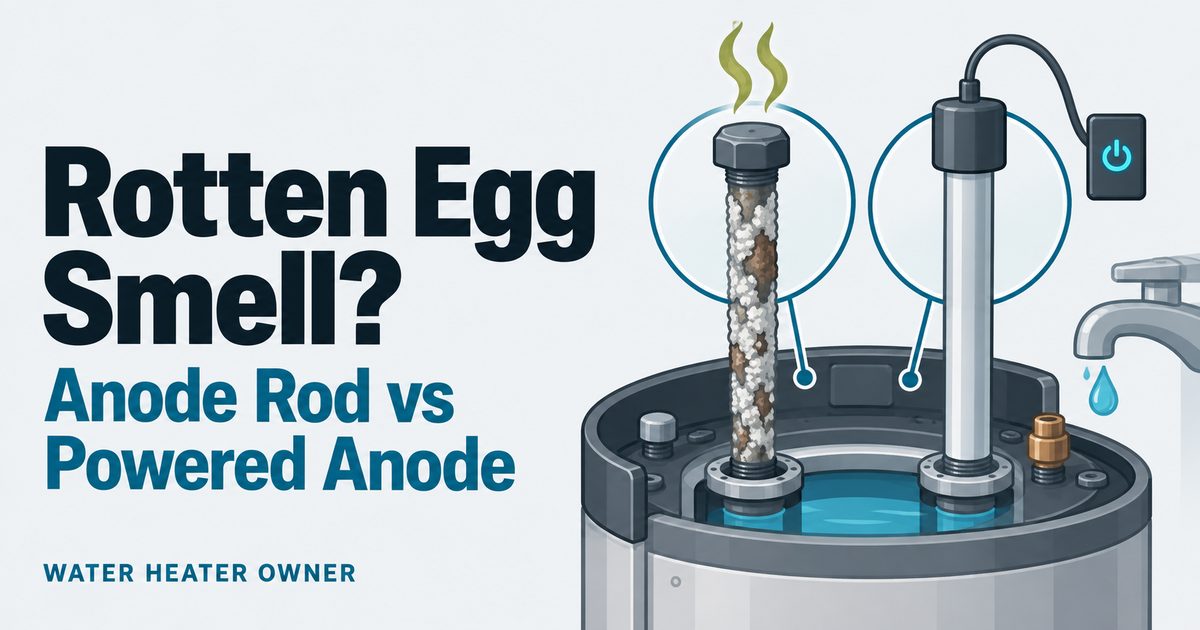
That rotten-egg smell in your hot water is hydrogen sulfide — typically bacteria in the tank reacting with sulfate in the water and the anode rod that protects the tank. Whatever you do, don’t just remove the anode: Rheem says running without it greatly shortens the tank’s life and voids the warranty. Sanitize the tank first (or have a plumber do it), then either swap in a less active anode (aluminum/zinc, typically around $30) or install a powered anode (typically $100–150), which doesn’t deplete like a sacrificial rod.
Why your hot water smells like rotten eggs
The smell is hydrogen sulfide (H₂S). The mechanism that owners, plumbers, and water-treatment companies consistently describe is this: harmless sulfate-reducing bacteria live in the warm, low-oxygen water inside a tank, feed on sulfate in your water supply, and give off H₂S as a byproduct. The standard magnesium anode rod makes it worse, because the reaction that protects your tank also releases hydrogen that fuels the process. Sulfate-rich water — common with wells — plus a magnesium rod plus a warm tank equals a smell that typically shows up on the hot side only.
This isn’t just forum lore. Rheem’s own manual for its Gen V hybrid says that water with high sulfate or mineral content, combined with the cathodic protection the anode provides, can produce hydrogen sulfide — the rotten egg odor — and notes that chlorination of the water supply should minimize the problem (AP23657 Use & Care, p. 29). A.O. Smith’s 2019 Voltex manual adds the bacterial side: harmless bacteria normally present in tap water can multiply in water heaters and give off a “rotten egg” smell.
One diagnostic step before you touch the heater: smell the cold water too. If the odor is in both hot and cold taps, the problem is your water supply, not the water heater, and no anode swap will fix it — that calls for a water test, not guessing by nose.
The one thing not to do: pull the anode and leave it out
Search this problem and you’ll find people cheerfully reporting that they yanked the anode rod and the smell disappeared. It probably did. So did the only thing standing between your steel tank and rust. In Rheem’s words, the anode rod “is slowly consumed, thereby eliminating or minimizing corrosion of the glass-lined tank.” Rheem’s manual is blunt about it: do not remove the anode; operating without it “will greatly shorten the life of the glass lined tank and will exclude warranty coverage” (AP23657, p. 29). GE’s GeoSpring troubleshooting guide points the same way on warranty — deal with the odor by substituting a less active anode material, possibly along with chlorinating the heater and lines; running without a GE-approved anode voids the warranty.
So the play is never remove. It’s replace — with something that protects the tank without feeding the smell. You have three moves, in order.
Fix 1 — Sanitize the tank
The smell comes from a living bacterial colony, so step one is knocking it down. The method plumbers use: shut the heater down, drain part of the tank, add a sanitizer — chlorine bleach or hydrogen peroxide are the standard choices — let it sit in the tank and hot lines, then flush thoroughly. The manuals point the same way at different scales: Rheem’s talks about chlorinating the water supply (p. 29), while GE’s GeoSpring guide says chlorinating the water heater and all hot water lines may be necessary — and to contact a local water professional or plumber for options and instructions.
I’m deliberately not giving you ounces-per-gallon here, because concentrations and dwell times vary by product and tank size — follow the sanitizer’s label, or have a plumber do the shock treatment, especially on a well (shocking a well system properly is its own procedure). Two safety notes before you drain anything: kill power at the breaker, then run a hot tap until the water runs cool — A.O. Smith’s manual asks for exactly that to reduce the risk of scalding, and Rheem’s warns the drained water may be hot enough to scald.
The honest caveat: many owners report the smell comes back if the magnesium rod stays in. Sanitizing is the reset button. The anode is the cure.
Fix 2 — Swap to an aluminum/zinc anode (~$30)
The classic fix: replace the magnesium rod with a less active material. GE’s guide describes the principle, and A.O. Smith’s 2019 Voltex manual names a specific option — a special zinc anode rod that “may help reduce or eliminate the odour,” with a qualified person doing the swap. In practice, the common choice is an aluminum/zinc alloy rod, which, as it’s usually explained, drives the protective reaction more gently and doesn’t feed the sulfide chemistry the way magnesium does. Many owners report that sanitizing plus an aluminum/zinc swap ended the smell.
It’s typically around $30, which makes it the budget answer. The trade-offs: it’s still a sacrificial rod — it depletes, and A.O. Smith’s 2019 manual has you inspect the anode after the first six months and at least annually after that — and a less active metal is, by design, less aggressive than magnesium, which is exactly why it doesn’t stink. Buy the right length and thread for your model; your manual’s parts list has the part number (Rheem lists its hybrid anodes on p. 39 of AP23657).
Fix 3 — A powered anode: the long-term fix
If you’d rather stop replacing anode rods, the answer is a powered anode — and this is genuinely clever engineering, not gadget marketing.
A.O. Smith’s service documentation for its PHPT hybrids explains the design: instead of a metal rod that corrodes sacrificially, a powered anode is an electrically isolated titanium rod driven by a small electronic control. The control monitors the tank and produces just enough voltage to stop galvanic corrosion; current flows from the titanium rod, through the water, to the grounded tank wall. Because the rod isn’t consumed, it doesn’t lose effectiveness over time (Service Handbook 321547-000, pp. 8, 27). That’s not the same as “never fails”: the control or the rod can still malfunction, and A.O. Smith’s 2012 Voltex manual says a malfunctioning powered anode should be replaced by a qualified technician. No magnesium, no depleting rod — and nothing feeding the sulfide reaction, which is why many owners report the smell is simply gone.
Some hybrids already shipped this way from the factory — A.O. Smith’s 2012 Voltex has a non-sacrificial powered anode that shouldn’t need replacing under normal operating conditions — but the 2019 Voltex uses a sacrificial anode rod, so check what you have before buying anything. For tanks with a conventional rod, the best-known aftermarket option is the Corro-Protec, typically $100–150 — check the maker’s current warranty terms. (I’m citing A.O. Smith’s documentation for how the technology works — different product, same principle.)
One real caveat, straight from the service handbook: a powered anode needs power to protect the tank. Don’t leave the unit unpowered for extended periods — and if you must, drain the tank to minimize corrosion (p. 8). My take: if your cabin breaker sits off all winter, drain the tank or stick with a sacrificial rod.
Replacing the anode on a heat pump water heater
The job itself is the same on a hybrid as on a standard electric tank, with one wrinkle: the top of a hybrid is crowded. The heat pump module sits where your swing room used to be — on A.O. Smith’s PHPT units the service handbook puts the powered anode inside the heat pump compartment, under the shroud (p. 27). Find yours in your manual before you buy tools.
Check who your manufacturer says should do this job before you start. GE’s GeoSpring guide says a qualified servicer or plumber should do the anode replacement. Rheem’s manual tells owners not to repair or replace any part it doesn’t specifically recommend, and it doesn’t walk owners through an anode swap. A.O. Smith’s 2019 manual includes anode inspection in its owner maintenance, with a qualified person as the alternative. If your manual doesn’t cover it, or you’re unsure, hand it to a plumber.
The sequence, with the hard numbers from A.O. Smith’s handbook — check your own model’s manual, because these are that platform’s figures:
- Kill power at the breaker. Not the display, the breaker. Then run a hot tap until the water is no longer hot — the handbook’s own step, and your protection against scalding.
- Depressurize: close the cold inlet valve, open a hot tap. If you need margin, drain a few gallons. Don’t use the T&P valve as your drain (Rheem’s manual does let you lift its lever to admit air when draining — with everyone kept clear of the hot water it releases).
- Break the rod loose with a 1-1/16” six-point deep-well socket and a breaker bar. Factory rods can be seriously stuck.
- Install the new rod with thread sealant, torqued to 50 lb-ft (handbook figures, p. 27). For a powered anode, connect its wire per the product’s instructions.
- Refill and purge: open the cold inlet, run a hot tap until water flows with no air, then restore power.
- On powered-anode units, be patient at startup. The PHPT handbook’s anode page says to wait 8 minutes for the dry-fire check before heating begins (its dry-fire section puts that routine at about four), and an anode fault can take up to 70 minutes to reappear — watch the display for that long before calling it done (p. 27). If a fault does show, the handbook’s service test (a technician’s check) is an ohmmeter between the anode tab and the tank: it should read 1 MΩ or more; a low reading means the rod is shorted.
An honest gut-check: breaking a seized rod loose, then torquing a new one to 50 lb-ft on top of a full, plumbed-in tank in a tight closet is a wrestling match. If that doesn’t sound like your Saturday, it’s a routine plumber job. What matters is that the tank ends up with an anode — the right kind.
If your unit is beeping or flashing something while you’re at all this, decode it first — the error codes guide and the Rheem beeping guide cover what each alarm means. And while you’re in there, it’s the perfect moment to clean the air filter.
FAQ
Does a powered anode really stop the rotten egg smell? Many owners report that it does — it removes the magnesium that feeds the sulfide reaction while still protecting the tank. Sanitize the tank when you install it so you’re not leaving an existing colony behind. If the smell survives all that, or shows up in your cold water too, the problem is the water supply — test it.
Aluminum vs magnesium — which anode for smelly water? Aluminum/zinc. As it’s usually explained, magnesium drives the reaction that feeds sulfide-producing bacteria; aluminum/zinc rods are the common way to follow GE’s advice to use a “less active material,” and A.O. Smith’s 2019 manual names a special zinc anode rod for odor. A powered anode is the step beyond either — no sacrificial metal at all.
Can I just remove the anode rod? No. The anode is the only thing corroding instead of your tank’s steel. Rheem’s manual says running without it greatly shortens the tank’s life and excludes warranty coverage; GE and A.O. Smith both say running without an (approved) anode voids the warranty. Replace it — never run without one.
Is the rotten egg smell dangerous? The manuals don’t answer that — A.O. Smith calls the bacteria harmless, not the gas. Your nose is not a water test: if the smell is strong, you’re on a well, or the odor is in the cold water too, get the water tested by a certified lab or ask your local health department what to test for, rather than guessing.

Dan Mercer — Dan Mercer is the pen name of Water Heater Owner’s editor. I’m not a licensed plumber or electrician, and I don’t sell or install water heaters. Every guide here starts from the manufacturers’ manuals and technical bulletins, is cross-checked against what owners consistently report, and says which is which — including what you can safely check yourself and when it’s a job for a licensed plumber or electrician.