Rheem Hybrid Water Heater Beeping? What Each Alarm Means
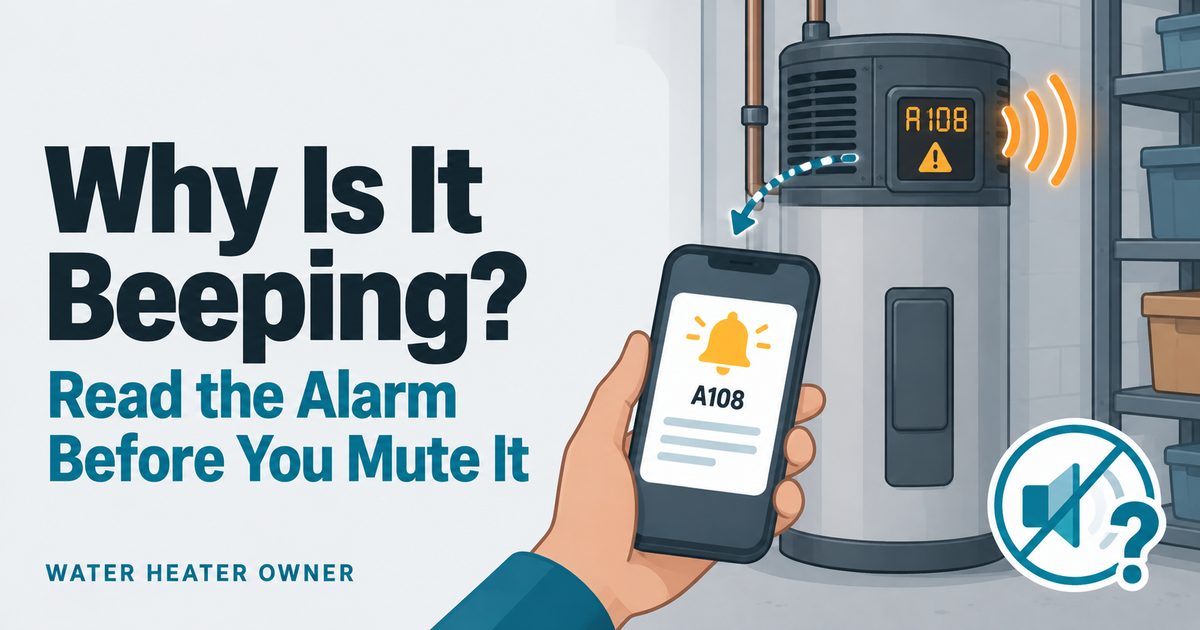
The beep itself isn’t the problem — it’s the messenger. Your Rheem hybrid beeps to flag an alarm, and the alarm is what you actually need to read on the front panel. The one owners report most is A108 (blocked condensate); the dirty-filter reminder, compressor trips (“Discharge Temp High”), and the leak sensor are the other usual suspects. Read the code first, fix that, then silence the beep — don’t just mute the messenger.
That last part is the trap. A common complaint on the forums is “it’s beeping in the garage and I just want it to stop” — and there is a mute setting, which I’ll show you. But many of these alarms also mean your heater has quietly switched from the heat pump to the electric elements, so a muted alarm costs you money every day it’s ignored.
First, read the code
The beeper is one-note; the code is specific. Two places to find it:
- On the panel: press NEXT until the display shows “Current Alarm,” then use the down arrow to scroll through any active alarms — that’s the procedure straight from the Gen V owner’s manual. The alarm history lives in the same Setting Menu if the beeping stopped before you got there.
- In the EcoNet app: the manual documents that its leak-detection alerts reach the app on your phone — handy when the heater is in the garage and you’re not. For every other alarm, the panel is the place the manual tells you to look.
One honest caveat: my references are Rheem’s Gen V “Universal Connect” manual (the 2024 edition). Older hybrids may organize their menus differently — if the button presses don’t match, go by your own model’s manual.
What each beep/alarm usually means
These are the alarms behind the beeping, from the Gen V manual’s alarm table. The full code-by-code rundown is in the error codes guide.
| Alarm | What it means | What to do | Urgent? |
|---|---|---|---|
| A108 — Condensate Blocked | Condensate isn’t draining; the rope sensor is wet. Heater defaults to the elements. | Clear the line, then dry the sensor — full walkthrough below | Not urgent in itself, but likely raising your bill |
| T131 — Clean Filter Reminder | Routine air filter maintenance is due | Wash and dry the filter (steps below) | No — but don’t skip it |
| A107 — Water Detected on Floor | The rope sensor found water in the drain pan | Look for a leak now; if none, the sensor may just be wet | Yes — rule out a real leak first |
| A004–A006 / T005–T006 — Compressor Shutdown | Compressor tripped (discharge/suction); heater defaults to elements | Check the fan runs and the filter is clean. The manual’s next step, inspecting the compressor for oily residue (a refrigerant leak), is the technician’s: Rheem warns the compressor’s wiring terminals can arc. With a leak or a dead compressor, the manual says the unit gets replaced, not repaired | Service call — owner checks stop at fan and filter |
| A101–A106 — Sensor failure | A temperature sensor reads bad. On A101/A102/A105/A106 the heater defaults to elements; on A103/A104 (tank sensors) the heater is disabled | Not much owner-side — note the code, call service | Service call; A103/A104 mean no heating until fixed |
| A008 — Dry Fire | Not enough water in the tank; heating disabled | Fill the tank, purge air at a hot tap — classic new-install issue | Yes — no hot water until resolved |
| A200 — High Water Temp (ECO) | The high-limit safety tripped; heater disabled | Manual: call tech service — the cause must be investigated by a qualified technician before the heater goes back in service | Yes |
Notice how many rows say “defaults to elements” — a beeping hybrid can easily be a hybrid running as a plain (expensive) electric heater, which is exactly the why-is-my-bill-so-high story.
A108 (condensate) — the one owners report most
Among owners, this is the beeper that comes up more than any other. A108 means the condensate the heat pump produces isn’t draining, so the moisture sensor in the drain path — the “rope sensor” — got wet and called it in. It isn’t an anode problem, and the control board is rarely the cause — Rheem’s bulletin ranks it the least likely, though still possible — despite what many owners assume when they start pricing parts.
The fix runs in Rheem’s order: find where the condensate goes and clear the line, dry the sensor and pan (per TB 1333 the sensor can stay unplugged 24–48 hours to dry — a diagnostic window, since nothing watches the condensate meanwhile), and only suspect the control board if the code survives both. The whole decision tree — including the meter check on the sensor and the unplugged-sensor test that isolates the board — is in Rheem A108: how to clear it. Meanwhile, know that an active A108 forces the heater onto the elements, so it’s the beep most directly connected to your bill.
Dirty filter and “discharge temp too high”
T131 — the filter reminder — is the friendliest beep on the list: it’s a scheduled nag, not a fault. The manual’s procedure: set the unit to Electric or Off, lift the filter out of its slot, wash it with mild detergent and water, let it dry, drop it back in, and restore your mode. The full filter how-to is here. Don’t snooze this one out of habit — a clogged filter chokes airflow, and starved airflow is one of the things that trips the next family of alarms.
“Discharge Temp High” is the manual’s own name for A005 and T005 (“Compressor Shutdown: Discharge Temp High”); the rest of the compressor-shutdown group is A004 (a discharge-suction trip) and A006/T006 (“Suction Temperature Too Low”). When one fires, the heater falls back to the elements — hot water keeps coming, at resistance-heat prices. The owner-side checks from the manual are refreshingly basic: confirm the fan is actually running and make sure the air filter is clean. The manual’s third step, inspecting the compressor for oily residue (the sign of a refrigerant leak), belongs to the technician: the compressor sits inside the unit, and Rheem warns its wiring terminals can arc and release flammable refrigerant and oil. If the compressor isn’t running or there are signs of leakage, the manual says the unit will need to be replaced, because Rheem doesn’t service sealed-system parts. Past those checks, it’s a technician’s job. I’m not an HVAC tech, and this is the one family of beeps where I wouldn’t pretend to be.
How to silence the beep without hiding the problem
Yes, the beeper has an off switch, and it’s documented, not a hack: in the panel’s Setting Menu there’s an ALARM BEEP entry — “Enable/Disable Alarm Sound” — where the up/down arrows switch it from Yes (the default) to no sound. That’s from the Gen V manual; older generations may bury it elsewhere or not offer it.
Use it with a rule: mute after you’ve read the code, never instead of reading it. Per the manual, the setting only enables or disables the alarm sound — it doesn’t fix anything, so the condition is still there. Muting an A108 you haven’t fixed means paying element rates indefinitely; muting an A107 without checking for a leak means finding out about the leak from the floor. For A107 specifically, the manual gives a better-scoped option: holding Clear Alarm for 5 seconds overrides that alarm for 24 hours — a temporary override for after you’ve ruled out a real leak, which beats a permanent mute.
If a nighttime beep is the complaint — a common one — fixing the cause will do more for your sleep than the mute switch, for reasons covered in the FAQ.
FAQ
Is the beeping an emergency?
Usually not — the most common causes (A108 condensate, T131 filter) are maintenance items, not hazards. The exceptions in the table above: A107 means possible water on the floor (check for a leak now), A008 means the tank isn’t full (don’t run it like that), and A200 means a safety tripped and the manual says to call tech service. Read the code; the code tells you the urgency.
Can I keep using hot water while it beeps?
In many cases yes. Many alarms — A108, compressor trips, most heat-pump sensor faults — make the heater default to its electric elements, so hot water keeps coming while the heat pump side sits out. You’re trading efficiency, not safety. The exceptions are the codes that disable heating entirely, like A008 (dry fire), A103/A104 (tank sensors), the element and relay errors A125–A129, and A200 (high-temp safety): those need fixing before normal use.
Why does it beep at night?
The manual doesn’t say, but here’s a likely reason: after the evening’s hot water use, the heat pump runs long recovery cycles — the most condensate (feeding a marginal A108) and the heaviest compressor load. Fix the underlying code and the 2 a.m. concerts should stop.

Dan Mercer — Dan Mercer is the pen name of Water Heater Owner’s editor. I’m not a licensed plumber or electrician, and I don’t sell or install water heaters. Every guide here starts from the manufacturers’ manuals and technical bulletins, is cross-checked against what owners consistently report, and says which is which — including what you can safely check yourself and when it’s a job for a licensed plumber or electrician.