Why Your Heat Pump Water Heater Uses So Much Electricity
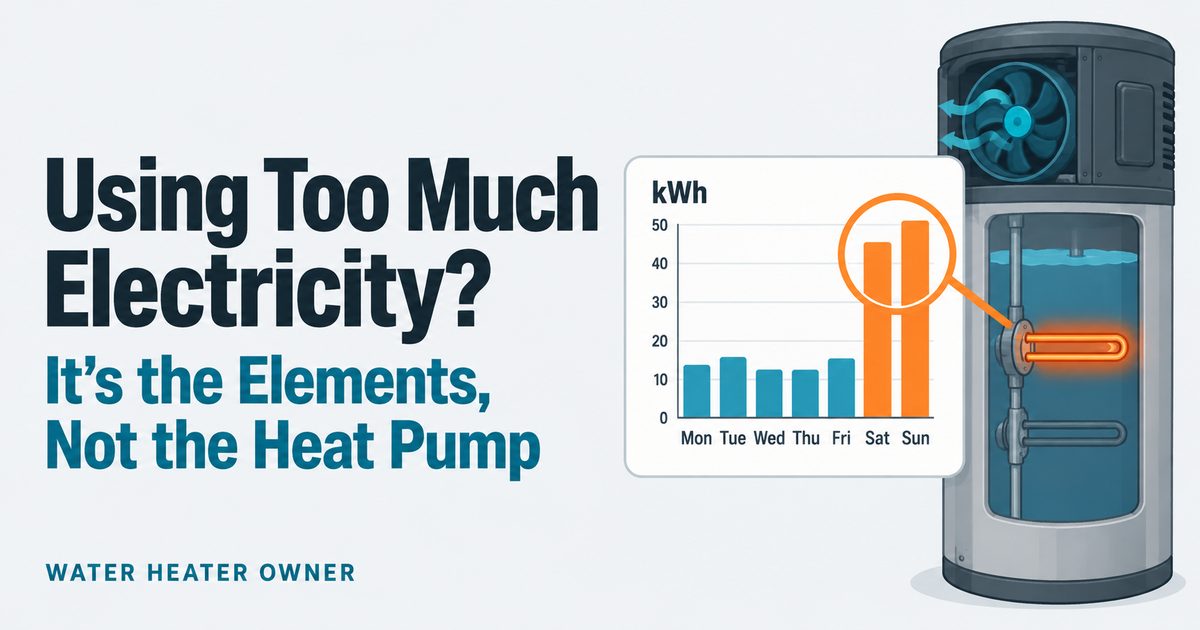
If your heat pump water heater is pulling 16–20 kWh a day, it’s most likely running on its electric resistance elements — not the heat pump. In true heat-pump operation, owners commonly report something like 2–5 kWh a day. The usual culprits: the wrong mode, a fault forcing backup heat, a cold or cramped install space, big draws outrunning recovery, or a setpoint that’s too high. Here’s how to confirm which one it is, and how to fix it.
I want to lead with the reassurance, because this question usually arrives as a small panic: I bought the efficient water heater and my bill went up — is it defective? Probably not. Most likely the compressor is fine; the machine has simply been making your hot water the expensive way, with a resistance element, for one of a handful of very findable reasons. This is the diagnosis, in order.
How many kWh should it actually use?
First, calibration. Rheem’s manual for the Gen V hybrids (AP23657) doesn’t publish daily consumption or UEF figures, so the ranges below are a rough guide — pieced together from owner reports and the element arithmetic in the next section — not factory specs. Treat them as order-of-magnitude, not gospel.
| Mode / scenario | Approx. kWh per day | What it tells you |
|---|---|---|
| Heat Pump mode, typical family | ~2–5 | Normal. This is the number you bought the thing for |
| Energy Saver, normal week | ~2–6 | Normal, with occasional element assists on heavy days |
| Heavy-use day (guests, laundry, long showers) | ~6–10 | Elevated but explainable — watch whether it settles back down |
| Elements doing the heating (any reason) | ~16–20+ | The red flag. This is standard-electric-tank territory |
That last row is the whole article. It’s what one element carrying the load for a few hours adds up to (the arithmetic is just below) — so when your hybrid posts those numbers, it isn’t behaving like a broken heat pump. It’s behaving like the resistance heater it secretly carries.
The #1 reason: it’s heating with the resistance elements
Inside a 208–240V Rheem hybrid there are two backup elements, upper and lower. The Gen V replacement parts list carries both 2,250- and 4,500-watt elements (AP23657, p. 39), and the manual sends you to the rating label on the front of the heater for the wattage your unit takes. Now do the arithmetic: if yours runs a 4,500-watt element, that element running a combined four hours across a day is 18 kWh. That can be the entire mystery. Nothing has to be broken, leaking, or defective — one element carrying the heating load for a few hours lands right in the range that made you search for this article.
The compressor is a different machine entirely. Per energy.gov, a heat pump water heater can be two to three times more efficient than a conventional electric resistance model — it moves heat from the surrounding air instead of generating it, so the same tank of hot water takes roughly a half to a third of the electricity. That’s why element-heavy days stand out so sharply against heat-pump days.
So the diagnostic question is never “why is my heat pump so inefficient?” It’s “why are the elements running?” — and that has a short list of answers.
How to check in EcoNet whether the elements are running
Before fixing anything, confirm the diagnosis. Three checks:
- The usage graph. Rheem’s manual doesn’t document one, but owners who use the EcoNet app’s usage view describe two signatures consistently: compressor operation is a low, steady draw over long stretches; element heat shows up as short, tall spikes. A day of skyline spikes points to element heat.
- The alarm list. On the panel, the Setting Menu includes Current Alarms and Alarm History (p. 24). This matters because of the next section — a fault can force element heat without you touching anything.
- Your ears. The heat pump runs a compressor and a fan you can hear; GE’s GeoSpring troubleshooting guide notes that on the elements the unit makes no fan or compressor sound. A tank that recovers quickly in total silence is likely running on resistance.
What makes the elements kick on
The main suspects:
1. The mode. If the heater is in Electric or High Demand, elements are simply what it uses — check this first, especially if someone bumped the mode during a houseguest weekend and never bumped it back. But here’s the subtler one: even Energy Saver, the factory default, keeps an element in reserve — the manual says heat pump operation provides primary heating “with one heating element engaging only if required by demand” (p. 24). Only Heat Pump and Vacation are limited to the compressor in normal operation (p. 22). Many owners on the heating forums additionally report pre-warm and override behavior — the unit firing elements ahead of expected demand. The full breakdown is in the modes guide.
2. A fault code. A whole family of alarms — blocked condensate (A108), compressor faults, low airflow, some failed heat-pump sensors — share one line in the manual’s troubleshooting table: “heating source defaults to elements” (p. 32). The unit keeps quietly delivering hot water at element prices. If usage jumped suddenly and the unit has been beeping, start here, not with the mode.
3. Demand outrunning recovery. In Heat Pump mode the manual rates recovery “Very Slow.” In Energy Saver, stack enough showers and laundry into one window and the demand-triggered element does what the manual says it will.
4. A cold install space. The compressor harvests heat from the air around the unit; in a garage or basement that gets cold it has less to harvest, works worse, and backup heat can carry more of the load. The thresholds differ by model and generation: A.O. Smith’s 2012 and 2019 Voltex manuals take the heat pump out of service below 45 °F ambient, its current hybrid’s below 37 °F; GE’s old GeoSpring lists 45 °F as the floor for its heat-pump modes, the relaunched GEOSPRING 35 °F; Rheem’s Gen V manual doesn’t print a single compressor cutoff. Details in the cold garage guide.
5. A cramped room or a runaway recirculation loop. Two causes Rheem’s manual names outright: installing in a confined space “will lead to higher power consumption if adequate ventilation is not provided” (p. 5), and “using an uncontrolled recirculation loop may cause the water heater to run excessively” (p. 13). If the unit lives in a closet, or your home has a recirculation pump without temperature control, look here.
6. A high setpoint. The higher the target — factory setting is 120 °F (p. 3) — the longer every recovery, and the more chances demand gives that element to engage. Setpoint changes are owner territory via the panel or app.
How to bring the usage (and the bill) down
- Put it in Energy Saver — or Heat Pump if you can live with slow recovery. Energy Saver keeps heat-pump economics with an element safety net; Heat Pump mode is the cheapest possible operation if your usage is spread out and your tank is big enough.
- Deal with any active alarm first. A mode change won’t fix a fault that’s defaulting to elements. Fix the cause behind the code, then re-judge the usage.
- Keep the setpoint reasonable. 120 °F is the factory setting for two reasons: efficiency and scald safety — the manual warns that water above 125 °F can cause severe burns. Adjust from the panel or the EcoNet app only.
- Space out the big draws. Showers in the morning, laundry at night gives the compressor time to do the work the element would otherwise grab.
- Keep the air filter clean. The unit itself reminds you (that’s alarm T131) — a starved airflow path hurts compressor performance, and airflow faults are on the defaults-to-elements list.
- What not to touch: the wiring, the internal thermostats, and anything behind the access panels. Diagnosing from the app is owner work; Rheem’s manual refers repairs to wiring, elements, the heat pump, and electronic controls to qualified service personnel.
Measure it, don’t guess
Everything above narrows the suspects; a measurement convicts one. My standing advice for any appliance suspicion is the same: put a number on it.
Your options depend on the model. The 208–240V hardwired units can’t take an inline plug-in meter, so use the EcoNet app’s usage view plus your utility’s hourly smart-meter data — compare a normal day against a heavy-use day and the element hours jump right out. If you have one of the 120V plug-in hybrids (a different design with its own manual — this article’s numbers don’t map onto it), don’t put a plug-in meter between its cord and the outlet: Rheem’s 120V manuals say the power cord should be plugged directly into a grounded receptacle. Use your utility’s hourly smart-meter data for it too. Cheap plug-in meters are still the honest way to settle every other “what’s eating the electricity” argument in the house. A methodical week of measuring beats a month of guessing. And if a persistent 16–20 kWh a day survives every check above — no alarm, no element signature — that’s the point to bring in a technician rather than keep theorizing.
FAQ
Is 20 kWh a day normal for a heat pump water heater?
Not in heat-pump operation. Owners commonly report roughly 2–5 kWh a day in Heat Pump mode for a typical household; 20 kWh is what a 4,500-watt resistance element (if that’s what your unit carries) adds up to over four-plus hours. It’s the signature of element heat — from the mode, a fault, cold ambient air, or heavy demand — not of a normal, healthy compressor doing the work.
Why did my bill jump after installing a heat pump water heater?
Check three things: the unit is in the wrong mode (Electric or High Demand), a fault code has it defaulting to the elements, or it replaced a gas heater — in which case you added a new electric load and the comparison belongs on the gas bill you no longer pay. If it replaced an electric tank and the bill went up, element heat is running; work the checklist above.
Does cold weather increase usage?
Yes, if the unit lives in an unconditioned space. The compressor pulls heat from the surrounding air, and A.O. Smith’s manual for its current Voltex says it plainly: at lower temperatures and humidity, “efficiency will be lower and recovery will take longer.” Longer recoveries mean more chances for element assistance. Expect winter usage above the summer baseline, and see the cold garage guide for what helps.

Dan Mercer — Dan Mercer is the pen name of Water Heater Owner’s editor. I’m not a licensed plumber or electrician, and I don’t sell or install water heaters. Every guide here starts from the manufacturers’ manuals and technical bulletins, is cross-checked against what owners consistently report, and says which is which — including what you can safely check yourself and when it’s a job for a licensed plumber or electrician.