Rheem Hybrid Water Heater Modes Explained (Which to Use)
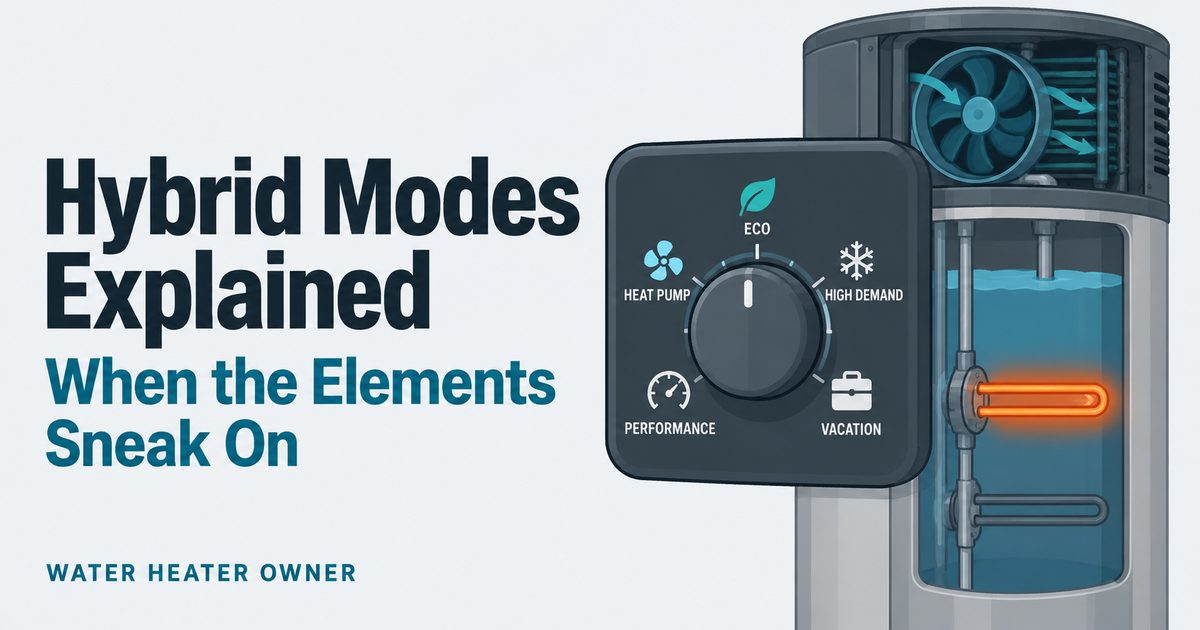
A Rheem hybrid has five modes — Energy Saver, Heat Pump, Electric, High Demand, and Vacation. Heat Pump draws the least power but recovers “Very Slow”; Electric draws the most. The catch most owners miss: in Energy Saver — the factory default — a resistance element can still fire when demand calls for it. Only Heat Pump and Vacation stick to the compressor in normal operation. For most homes, Energy Saver is still the right default.
That catch is one of the biggest sources of confusion in hybrid owner forums. You leave the unit in the efficient-sounding mode it shipped in, and one day the usage numbers don’t look like heat-pump numbers. Nothing is broken. The manual says this is how it works — quietly, on page 24, in one sentence almost nobody reads.
This guide uses the Rheem Gen V “Universal Connect” hybrid (the 208–240V models, 40–80 gallon) and its Use & Care Manual, AP23657 (2024), as the source. Older generations may use different mode names or logic — if yours isn’t a Gen V, check its own manual before assuming it behaves the same.
A note on the 120V plug-in models: everything here describes the 208–240V hardwired hybrids, which carry electric backup elements. Rheem’s 120V plug-in version is a different design with its own manual — not the AP23657 — so don’t map these modes onto it one-to-one.
The five modes at a glance
| Mode | What it uses | Recovery speed | Efficiency (manual’s rating) | Can the elements kick on? |
|---|---|---|---|---|
| Energy Saver (factory default) | Heat pump first; one element assists on demand | Fast | Very High | Yes — by design. “One heating element engaging only if required by demand” (manual, p. 24) |
| Heat Pump | Compressor only | Very slow | High | No — “will not use any electric heat during typical heating and demand cycles” (p. 22). The one honest exception: fault codes (see below) |
| Electric | Elements only | Fast | Very Low | They’re all it uses. Rheem says this mode is for compressor maintenance periods, not daily life (p. 22) |
| High Demand | Compressor and elements at the same time | Very fast | Low | Yes — always, on purpose (p. 22) |
| Vacation | Compressor as needed to hold the tank at ~82 °F | None | Very High | No — “only compressor operation will be allowed as needed” (p. 22) |
The recovery and efficiency labels come from the manual’s own comparison table (p. 24). The last column — whether the elements can fire — is the one Rheem doesn’t put in a table, and it’s the one that decides your bill.
Energy Saver vs. Heat Pump — the two that matter day-to-day
These are the only two modes most owners should ever toggle between, so let’s be precise about the difference.
Energy Saver is what your heater shipped in (along with a 120 °F factory setpoint, per p. 3). It’s tuned to maximize compressor use and minimize the elements — but it keeps one resistance element in reserve, and the exact language matters: heat pump operation “provides primary heating, with one heating element engaging only if required by demand” (p. 24). Translation: back-to-back showers, a soaking tub, laundry on hot — anything that pulls the tank down faster than the compressor can climb back — and the element steps in to close the gap. Not a malfunction. The design.
Heat Pump (some panels label it Heat Pump Only) is the purist mode. The manual commits to it: the heater “will heat with compressor operation only and will not use any electric heat during typical heating and demand cycles” (p. 22), and says the mode will “minimize power consumption.” It’s also the slowest. The manual rates its recovery “Very Slow,” and it means it. Run the tank down and you’ll wait, because a compressor moving heat out of the surrounding air simply can’t match a resistance element dumped straight into the water.
So which one? My honest recommendation: Energy Saver for most households. You keep heat-pump economics the vast majority of the time, and the element bails you out on the occasional heavy day instead of leaving someone in a cold shower. Switch to Heat Pump mode if your usage is steady, your tank is decent-sized, and you’d rather plan around slow recovery than pay for backup heat — and watch your first week, because that’s the trade you’re making.
When the elements turn on even in “efficient” modes
Here’s the part most mode explainers skip. There are three separate paths by which a hybrid ends up running resistance heat while you believe you’re in an efficient mode.
1. Demand engagement in Energy Saver. Covered above, and worth repeating because it’s the common one: Energy Saver reserves the right to fire an element whenever demand outruns the compressor (p. 24). If your household regularly stacks its hot-water use into one window, that element may be a regular guest.
2. Pre-warm and override behavior. Beyond the manual’s one sentence, many owners on the heating forums report that Rheem hybrids will override your expectations — pre-warming the tank with the elements ahead of anticipated demand, or falling back to resistance when a recovery takes too long. I treat the specifics as community observation rather than spec — Rheem doesn’t publish its control logic — but it describes the same mechanism the manual confirms in print: the machine, not you, decides when an element is “required by demand.”
3. Fault fallback. This one surprises people the most. A whole group of alarm codes — a blocked condensate line (A108), compressor trouble, low airflow, some failed heat-pump sensors — carry the same consequence in the manual’s troubleshooting table: “heating source defaults to elements” (p. 32). (Not every code does: some, like A103/A104 or A200, disable the heater instead.) The heater quietly keeps making hot water, just at element prices. You didn’t change the mode; a fault changed it for you. If your usage jumps and the unit is beeping, or the app shows an active alarm, this is the first thing to rule out.
The takeaway isn’t that hybrids cheat. It’s that “mode” is a request, not a guarantee — except in Heat Pump and Vacation, the two modes whose printed descriptions limit them to the compressor in normal operation.
High Demand and Electric — when speed beats savings
High Demand runs the compressor and the elements simultaneously (p. 22). Recovery is rated “Very Fast,” efficiency “Low.” It’s the house-full-of-guests mode — genuinely useful, as long as you remember to turn it back off. As a permanent setting, you’re paying resistance prices with a compressor surcharge.
Electric shuts the compressor out entirely and heats on elements alone — the manual says it “should only be used during compressor maintenance periods” (p. 22). That’s the practical use: the compressor is down and you’re waiting on service. (Some other brands’ manuals suggest Electric in winter to stop the cold-air output; Rheem’s Gen V manual doesn’t — if your unit sits somewhere cold, the cold garage guide covers it brand by brand.) Used as a daily driver, Electric turns your hybrid into the very tank you replaced — with the bill to match.
Vacation — small mode, real savings
Vacation mode holds the tank at roughly 82 °F using the compressor as needed, for a period you set — 2 to 28 days, or “Hold” indefinitely until you cancel it (p. 22). The manual rates its efficiency “Very High,” and it just keeps the tank idling. Set it to end the day you come home and you’ll have hot water waiting instead of an 82-degree shower.
How to see what your heater is actually doing
You don’t have to guess which heat source ran. Three checks, from quickest to most thorough:
- Listen. The heat pump runs a compressor and a fan you can hear; the elements have no moving parts. (GE’s GeoSpring troubleshooting guide says it plainly: on the elements, the unit won’t make fan or compressor sounds.) If the tank is recovering fast and the top of the unit isn’t humming, that quiet likely means resistance heat.
- Check the panel for alarms. The Setting Menu includes Current Alarms and Alarm History (p. 24). Any active code from the defaults-to-elements family means the mystery is solved — start with the code, not the mode.
- Watch the usage in EcoNet. Rheem’s manual doesn’t document an energy report, but owners who use the EcoNet app describe its usage view the same way: heat pump operation draws a few hundred watts in long, patient stretches, while element heat shows up as short, tall spikes. If your graph looks like a city skyline, elements are probably running. For what those numbers should look like — and what 16–20 kWh a day really means — see why your heat pump water heater uses so much electricity.
One safety line, since mode-hunting sometimes tempts people further: changing modes and setpoint from the panel or the app is owner territory. Anything behind the access panels — wiring, the internal thermostats, the ECO — is not. Rheem’s manual says not to attempt repairs to wiring, heating elements, the heat pump, or electronic controls and to refer them to qualified service personnel.
FAQ
Which mode is cheapest?
Heat Pump draws the least power: the manual commits to running it “with compressor operation only” and says it will “minimize power consumption” (p. 22). But Rheem’s own efficiency table rates Energy Saver highest (“Very High,” with “maximum savings,” p. 24), and it recovers much faster; it just spends element power occasionally when demand is heavy. Electric is the most expensive — the manual says it “will result in maximum power consumption” — and High Demand is rated “Low” efficiency.
Will Heat Pump mode leave me short on hot water?
It can, and the manual is upfront about it: recovery is rated “Very Slow” (p. 24). Whether that bites you depends on tank size and habits. A large tank and spread-out usage — fine. A small tank, a big family, and stacked morning showers — expect to run short, and consider Energy Saver as the smarter compromise rather than fighting it.
Does switching modes often hurt the unit?
Nothing in the manual suggests it does. Modes are an owner-facing control on the panel and the EcoNet app, and the manual describes changing them without attaching any caution — it doesn’t promise anything either way. Switching to High Demand for a weekend of guests and back on Monday is exactly the intended use. What you shouldn’t do is leave Electric on permanently (it’s designated for compressor maintenance periods) or use mode changes to mask a fault code that’s forcing element heat anyway.

Dan Mercer — Dan Mercer is the pen name of Water Heater Owner’s editor. I’m not a licensed plumber or electrician, and I don’t sell or install water heaters. Every guide here starts from the manufacturers’ manuals and technical bulletins, is cross-checked against what owners consistently report, and says which is which — including what you can safely check yourself and when it’s a job for a licensed plumber or electrician.