Heat Pump Water Heater in a Cold Garage: Min Temp by Model
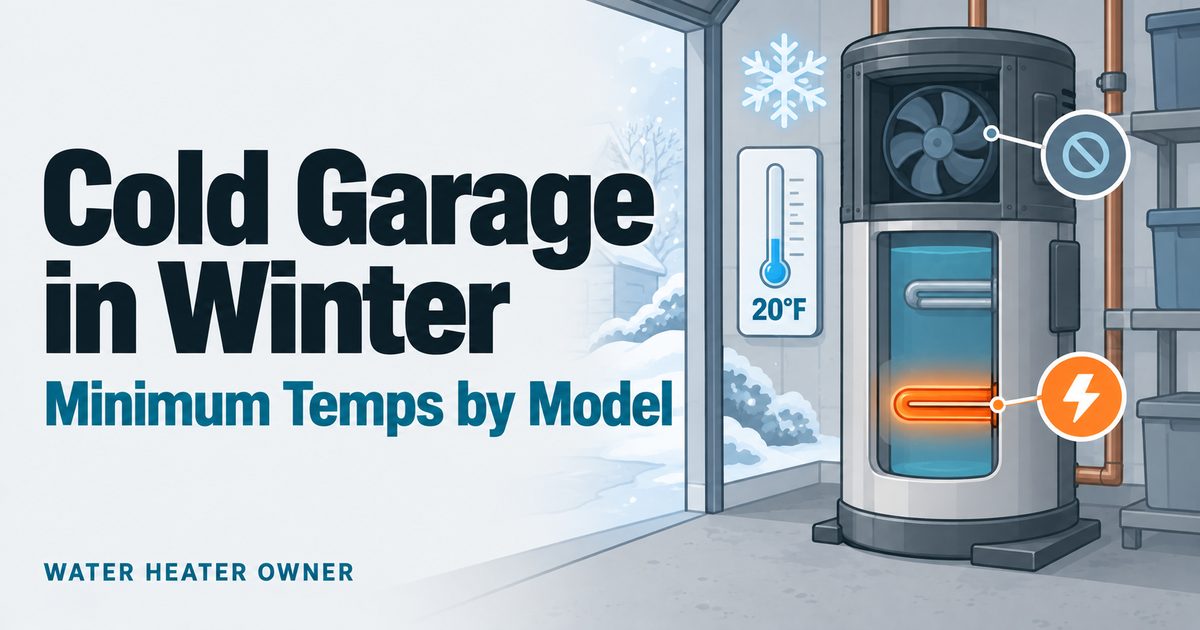
A heat pump water heater needs the air around it warm enough to run the compressor — the U.S. Department of Energy’s general guidance is a space that stays roughly in the 40-90 °F range. Where each unit actually gives up depends on the model and its generation: A.O. Smith’s 2012 and 2019 Voltex switch to their electric elements below 45 °F ambient, its current hybrid (March 2025 manual) below 37 °F; GE’s old GeoSpring lists 45 °F as the floor for its heat-pump modes, the relaunched GE Profile GEOSPRING 35 °F; and Rheem’s Gen V manual prints no single compressor cutoff — only a 32 °F freezing limit for the location.
If yours lives in an unheated garage or basement, the question isn’t whether cold weather changes how it behaves — it’s at what temperature, what it costs you, and what’s worth doing before winter hits.
The minimum temperature, model by model
The number everyone wants — “the heat pump quits below X degrees” — is published per model, not universally. Here’s what the documentation actually says:
| Unit | What the book says | Source |
|---|---|---|
| A.O. Smith Voltex, 2012 (60/80 gal) | In Efficiency mode the elements stay off unless ambient is below 45 °F or above 109 °F — outside that range the elements take over and the heat pump doesn’t run | Voltex Use & Care manual 318257-002 (2012), pp. 4, 14 |
| A.O. Smith Voltex, 2019 (50/66/80 gal) | Heat pump runs between 45 °F and 120 °F ambient — and not at all if the tank water is below 59 °F. Outside that, the unit runs in electric mode until conditions return, and the display shows HPO (normal, no action needed) | Voltex Use & Care manual 100323093 (2019), pp. 16-18, 20 |
| A.O. Smith hybrid, current generation (50/66/80 gal, manual dated March 2025) | Heat pump runs between 37 °F and 120 °F ambient — and not if the average tank water is below 55 °F. Outside that, the elements carry the load, the heat pump sits out in both Heat Pump and Hybrid modes, and the display shows HPO | A.O. Smith Use & Care manual 100379659 (2025), pp. 9, 19-20 |
| Rheem Gen V hybrid (40-80 gal, 208-240 V) | No single compressor cutoff printed. The location limits: protect it from freezing (below 32 °F) and from high temperatures (above 140 °F); if the air drops more than 15 °F during heat pump operation, it needs more air circulation. A130 is a freeze warning: the unit is off and the air is below freezing — the fix is to turn it on | Rheem AP23657 Gen V manual, pp. 20, 30, 33 |
| GE GeoSpring (2012-2016) | Location should be 45-120 °F for its heat-pump modes and 32-150 °F for Standard Electric mode; it carries a dedicated ambient temperature sensor (fault code F-8 when it fails) | GeoSpring owner’s manual troubleshooting and fault-code pages |
| GE Profile GEOSPRING (2025+) | Heat pump operating range 35-120 °F; outside it, the heat pump turns off and the electric elements run until the room is back in range | GE owner’s manual 49-6000330, pp. 23, 28 |
| General guidance (any brand) | Roughly 40-90 °F and about 1,000 cubic feet of air around the unit — general guidance, not a manufacturer requirement (the manuals above ask for 450-750 cubic feet) | U.S. Department of Energy (energy.gov) |
Two honest caveats. The Rheem manual cited covers the 208-240 V hardwired Gen V; the 120 V plug-in models are a different design with their own manuals (AP21914 and AP22654), and those don’t print a compressor cutoff either — only the same protection from freezing (below 32 °F). And figure out which GeoSpring you have: the orphaned 2012-2016 units and the relaunched ones are documented completely differently.
The pattern: the older manuals put the heat-pump floor at 45 °F; the current A.O. Smith and GE manuals go lower, to 37 °F and 35 °F. Rheem’s Gen V manual doesn’t print one. If your garage spends January below your model’s floor, the next section is your winter.
What actually happens below the threshold
Nothing breaks, and nothing beeps — the 2019 Voltex just shows HPO on its display. The unit quietly stops being the appliance you paid extra for.
On the units that publish a floor, the control hands the job to the electric resistance elements below it — resistance heat, like a plain electric tank’s (the 2012 Voltex pairs a 4,500 W upper with a 2,000 W lower element; your rating label says what yours carries). A.O. Smith’s manuals and GE’s 2025+ manual spell that out. Rheem’s Gen V manual doesn’t describe a cold-weather fallback: its “heating source defaults to elements” line belongs to fault codes, not to room temperature. And in Heat Pump mode it says the unit won’t use electric heat during typical cycles — so in a cold room, expect slow recovery rather than an automatic switch.
Translated to your bill: the hybrid’s entire pitch is that the compressor makes hot water on a fraction of the electricity the elements need. When the elements carry the winter, that advantage is gone — a hybrid on its elements all winter bills you like the plain electric tank you replaced. Owners commonly report 16-20 kWh days in that state — the full breakdown is in why your heat pump water heater uses so much electricity.
And it’s not a cliff, it’s a slope. A.O. Smith’s 2019 manual says it directly: at lower temperatures and humidity, “efficiency will be lower and recovery will take longer.” Many owners in cold-climate threads add that the elements chip in more as the garage cools through the 50s and 40s, before any hard cutoff.
Yes, it cools the room
The physics people skip at purchase time: the heat in your water is pulled out of the air in the room. A heat pump water heater is a small air conditioner that exhausts its cold air right where it stands.
The manuals own this. A.O. Smith’s 2012 Voltex manual credits the unit with up to half a ton of cooling and dehumidification for the surrounding space — pleasant in a Georgia garage in July, exactly backwards in a Michigan garage in January. It’s also why the siting rules exist: the Department of Energy’s general guidance is about 1,000 cubic feet of air, while the manufacturers’ own minimums are lower — Rheem’s Gen V manual wants more than 700 cubic feet before you need added ventilation, A.O. Smith asks for 750 (2012), 700 (2019) or 450 (its current hybrid), and GE 700. In a small, cold, closed room, the unit is chilling the very air it needs to stay above its own threshold — a feedback loop working against you. Rheem’s manual even names the symptom: if the air temperature drops more than 15 °F during heat pump operation, the unit needs more air circulation around it.
How cold does it get? The dramatic numbers are anecdotal: many owners on the building-science and heating forums describe the unit “sucking the heat out” of a marginal space and pulling an already-cool basement or garage down toward the ~40 °F mark over a winter. Owner experience, not a spec — but a consistent report, and it squares with the half-ton figure. (The flip side — “free basement dehumidifier!” — deserves the same honesty: owners who’ve tracked runtime report these units run a small fraction of the day, so the dehumidification is real but modest.)
What to do before winter hits
You have four realistic options, and none of them is “force it to be efficient in a near-freezing garage.”
1. Switch modes for the season — where your manual supports it. A.O. Smith’s 2012 Voltex manual suggests Electric mode in winter to stop the unit putting out cold air. That advice doesn’t carry over: on the 2019 Voltex, Electric mode reverts to the default after 48 hours, and Rheem’s Gen V manual reserves Electric for compressor maintenance periods. Wherever you do use it, it’s the expensive mode — set a reminder to switch back in spring; paying element rates in May is the classic own-goal. What each mode does, and when the elements sneak on anyway, is in the modes guide. And know how your unit’s efficient mode behaves in the cold: on a Rheem, Heat Pump mode promises not to use electric heat during typical cycles, so in a cold garage it can leave you with very slow recovery; the Voltex’s Efficiency mode switches to the elements on its own below 45 °F, and A.O. Smith’s current hybrid and GE’s relaunched GEOSPRING do the same below 37 °F and 35 °F.
2. Duct it. Rheem’s Gen V and A.O. Smith’s 2012 Voltex both document ducting (Rheem’s inlet takes 8-inch duct and its outlet 10-inch; A.O. Smith sells inlet and outlet duct kits for the 2012 Voltex). Ducting lets the unit borrow air from — or dump cold air into — somewhere better than a closed garage bay. It’s an installer conversation, not a weekend hack: room volumes, duct lengths, and (see the noise guide) vibration isolation all have manual-specified requirements.
3. Accept the resistive winter. Genuinely fine, and for many northern owners the right call: the hybrid earns its keep eight or nine months a year and runs as a normal electric tank for the coldest stretch. Budget for the winter bills and let it be.
4. Warm the space. Air-sealing and insulating the garage, or relocating the unit to conditioned space, attacks the root cause. Relocation is a real project — plumbing, electrical, condensate, and a tank that weighs several hundred pounds full (A.O. Smith’s tables put a full 80-gallon Voltex at 967 lb for the 2012 model and 921 lb for the 2019) — so it’s drain-it-and-hire-help territory, not a dolly and a buddy.
Will it freeze or get damaged?
Cold enough air stops being an efficiency problem and becomes a hardware problem.
Rheem builds in an explicit warning for this: alarm A130 — “Unit Off / Air Temp Freezing: Enable Unit.” Per the manual, it’s a freeze warning — the ambient temperature is below freezing — and the fix it gives is to select a mode and turn the heater on. In other words: don’t leave a Rheem switched off in a garage that freezes. If you see A130, turn the unit on, and then deal with the room.
Around the freezing mark, three things are at risk: the water piping, the T&P discharge line, and the condensate line — a thin, gravity-drained trickle of water that freezes readily where it exits through a cold wall. A.O. Smith’s 2019 manual is specific: in garages and basements, the water, condensate, and drain piping may need insulation to guard against freezing, and condensate lines in areas subject to freezing should be wrapped with a nationally recognized heat tape, installed per its maker’s instructions. A frozen condensate line backs the system up, which on a Rheem can eventually surface as the A108 condensate alarm and a unit running on its elements.
If the space can freeze while the unit sits idle — a seasonal home, a long vacancy — don’t just flip the breaker and leave. Both Voltex manuals warn against leaving the unit unpowered for extended periods — if the power must be off long-term, drain the tank completely (the 2012 manual’s reason: its powered anode needs electricity to protect the tank). Both brands offer a Vacation mode — Rheem holds around 82 °F using only the compressor, the Voltex around 60 °F (50 °F on A.O. Smith’s current hybrid). A.O. Smith’s manuals specifically recommend Vacation to keep the water heater from freezing in cold weather; Rheem’s manual doesn’t make that promise, so in a garage that freezes, don’t count on Vacation alone. For a true winter shutdown, have a plumber drain and winterize it: Rheem’s manual says the heater and piping should be drained if they might be exposed to freezing, and that a qualified service person should check the controls after a long shutdown. Draining a pressurized tank and its lines correctly is their job, not a blog post’s.
FAQ
What’s the minimum temperature for a Rheem hybrid water heater? Rheem doesn’t print one compressor cutoff in the Gen V use & care manual. What it does print: protect the location from freezing (below 32 °F), add air circulation if the room drops more than 15 °F while the heat pump runs, and an A130 freeze warning if the unit is off in freezing air — turn it on. The Department of Energy’s general guidance for the category starts around 40 °F. Check your exact model’s spec sheet rather than trusting a blanket figure.
Does a heat pump water heater make the garage colder? Yes — by design. It moves heat from the air into the water; A.O. Smith’s 2012 Voltex manual rates it at up to half a ton of cooling for the space. In a big or mild garage you’ll barely notice; in a small northern garage, many owners report it dragging an already-cold space down toward the low 40s over the winter.
Should I duct my heat pump water heater? If it sits in a space that’s too small (under the 450-750 cubic feet the manufacturers ask for) or too cold, ducting the intake or exhaust to a better space is the standard fix — Rheem and A.O. Smith both document ducting options. Get the room-volume and duct-length limits from your model’s installation manual, and have the sizing conversation with an installer.
What happens below 40 °F? It depends on the model and mode. The 2012 and 2019 Voltex and GE’s old GeoSpring put their floor at 45 °F, and the Voltex switches to its elements below it: higher bills, normal function. A.O. Smith’s current hybrid and GE’s relaunched GEOSPRING keep the heat pump running down to 37 °F and 35 °F, then switch to their elements the same way. A Rheem in Heat Pump mode won’t use electric heat during typical cycles, so expect very slow recovery instead. At freezing, the pipes and condensate line become the real risk — and a Rheem that’s switched off will show A130 telling you to turn it on. Below freezing, the emergency is the room, not the appliance.

Dan Mercer — Dan Mercer is the pen name of Water Heater Owner’s editor. I’m not a licensed plumber or electrician, and I don’t sell or install water heaters. Every guide here starts from the manufacturers’ manuals and technical bulletins, is cross-checked against what owners consistently report, and says which is which — including what you can safely check yourself and when it’s a job for a licensed plumber or electrician.