Heat Pump Water Heater Too Loud? Normal dB + How to Quiet It
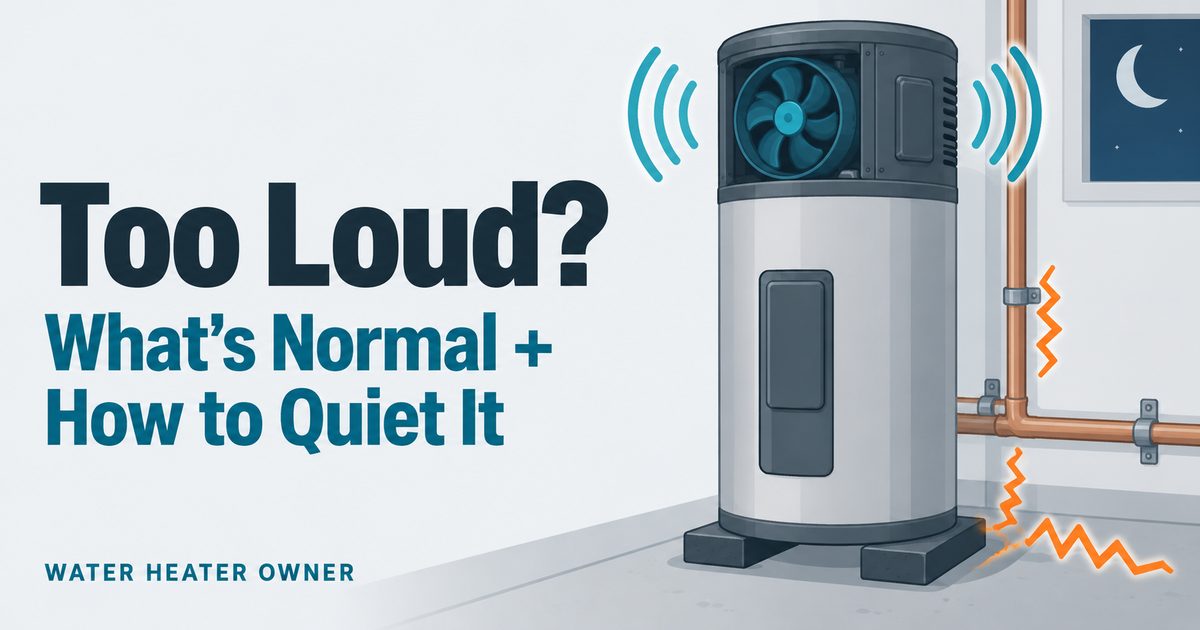
A heat pump water heater runs a compressor and a fan, so a steady hum while it’s heating is normal — owners who’ve measured theirs typically report somewhere in the 45-55 dB range — clearly audible in the same room. What’s not normal is vibration that travels through the floor or the pipes and shows up as a hum or rattle in another room. Start cheap: isolate the unit, then decouple the plumbing, then deal with the room.
How loud is “normal”?
Here’s something that surprised me when I went looking: the owner’s manuals don’t publish a decibel number. I’ve been through the Rheem Gen V use & care manual and the A.O. Smith Voltex guide, and neither prints a dB spec — so any article handing you a tidy dB-by-model table is pulling from marketing sheets or making it up. If you want an official number for your model, the manufacturer’s spec sheet is the place to check; the manual won’t have it.
What owners who’ve actually measured it report — phone apps and cheap SPL meters, mostly on the building-science and HVAC forums — is typically around 45-55 dB while the compressor runs. For calibration: a modern refrigerator is around 40 dB, normal conversation around 60. Clearly audible in the same room; shouldn’t dominate the house.
What you’re hearing is mostly three things:
- The compressor — a steady motor hum, the dominant sound.
- The fan — a whoosh of air being pulled through the top of the unit.
- The refrigerant — hissing, gurgling, sometimes an almost musical “singing” as it moves through the coil.
A.O. Smith’s 2012 Voltex manual has a “Water Heater Sounds” section that lists the heat pump compressor or fan running as a common sound — normal, documented operation, not a defect. A steady hum-plus-whoosh that starts and stops with the heating cycle is the design working. The hissing and singing get a caveat, though: Rheem’s manual notes that most appliances make some sound, but if that hissing or singing “increases excessively,” it says to have a qualified installer or plumbing contractor inspect the unit.
Normal noise vs. a noise that means something
The dividing line isn’t loudness — it’s where the sound travels and what kind it is.
Normal: steady, airborne, loudest next to the unit, fades with distance and a closed door. Cycles on and off with heating demand. Boring.
A symptom worth chasing:
- A hum you can hear (or feel) rooms away. Airborne sound doesn’t do that at these levels — vibration through the slab, framing, or water pipes does. Noise as loud in the bedroom as beside the tank is a transmission problem, not a loud machine.
- Rattles and buzzes. A panel, a loose screw, a pipe strap, or something near the heater being excited by the compressor’s frequency. Resonances — the machine is fine, something else is singing along.
- A low tone that seems to fill certain rooms. Some Rheem Gen 5 owners on the forums describe a persistent low-frequency tone that carries into the house even when the measured dB level is modest. A community report, not a documented defect, but it matches the physics: low frequencies travel through structure, and the decoupling fixes below are your best shot at it.
- New noises. A unit that ran quietly for a year and now grinds, screeches, or rattles metallically has changed. That’s the last section of this article.
Quieting it down, cheapest first
Work this list in order; the first two steps are the cheap ones.
1. Isolate the unit from the floor (~$20-40)
Anti-vibration pads — the ribbed rubber or rubber-cork sandwich pads sold for washing machines and compressors — break the vibration path between tank and floor. It’s the cheapest fix, and many owners report it’s the one that solved their “hum through the house” problem. Rheem’s own version is a Vibration Isolation Kit (SP20883), which the Gen V manual lists for installation on non-concrete floors; generic pads under a unit on a concrete slab are an owner practice, not a manual recommendation.
Two cautions before you slide pads under anything:
- The unit must stay level, and the condensate must still drain. A heat pump water heater makes condensate constantly, and it drains by gravity. Tilt the unit and you can end up with condensate pooling where it shouldn’t — which on a Rheem can end in the A108 condensate alarm and the machine falling back to its expensive resistance elements. Use pads rated for the load, check level after, and confirm the drain line still runs downhill.
- A full tank weighs as much as a piano. A.O. Smith’s own manuals put a full 80-gallon Voltex at 967 pounds (2012 model) or 921 pounds (2019 model). You do not tip or “walk” that onto pads. Draining it first means shutting off the power and handling water hot enough to scald — both warnings are in Rheem’s manual — so drain it carefully, or have a plumber do it during other service.
2. Decouple the plumbing (~$0-50)
Rigid copper is a sound conductor running straight into your framing. If the hum rides the pipes:
- Cushion the pipe straps. Anywhere the hot and cold lines are strapped hard to studs or joists near the heater, add rubber-lined (cushioned) clamps or slip foam between pipe and wood. Ten-minute job, no plumbing opened.
- Check where pipes touch the structure. A pipe resting against a joist transmits; a half-inch of clearance or a foam sleeve silences it.
- Flexible connectors. Corrugated flex connectors at the tank break the rigid path entirely — Rheem’s manual recommends flexible connectors on the water lines precisely for vibration isolation. Swapping them in means opening the heater’s pressurized water lines, so it’s a plumber job — a quick, cheap one, worth bundling with any other service call.
3. The room and the location
If the unit sits outside a bedroom wall, sometimes no amount of isolation makes 45-55 dB acceptable, and the answer is the room itself: insulation on the shared wall — or, in the extreme case, relocating the unit. What you shouldn’t do is seal the unit’s room tight to block sound: a heat pump water heater needs air. Rheem’s manual wants a room larger than 700 cubic feet (or added ventilation) and warns that a confined space without adequate ventilation raises power consumption; GE’s old GeoSpring guide calls for a louvered door in rooms under 700 cubic feet. A solid door or weatherstripping only makes sense if the room meets its air requirement on its own. Relocating is a real project (plumbing, electrical, and condensate all move with it), and where it lives also affects performance — read the cold garage guide before you exile it to an unheated space.
One manual-backed detail: if your unit is ducted, Rheem’s Gen V installation instructions call for a flexible duct section, at least 12 inches, between the unit and any rigid duct — precisely so compressor vibration doesn’t telegraph down the duct run. If your installer hard-piped rigid duct straight onto the unit, you’ve found your noise problem, and the fix is that flex section, not a quieter machine.
4. The nighttime workaround: Electric mode
The Rheem, A.O. Smith, and GE hybrids covered here each have a mode that runs the resistance elements only — no compressor, no fan, effectively silent. Switching to Electric overnight can work as a short-term stopgap while you work through the list above.
Just go in with your eyes open: it’s the most expensive way to make hot water, and it’s outside what Rheem designed the mode for. Rheem’s manual rates Electric mode’s efficiency “Very Low” and says it “should only be used during compressor maintenance periods” — not daily driving. (On A.O. Smith’s 2019 Voltex, Electric mode reverts to the default after 48 hours anyway; its current hybrid runs Electric on a 1-7 day timer.) The elements draw resistance-tank wattage the whole time they run, which is exactly the electricity-bill trap that surprises hybrid owners. Use it as a patch, not a lifestyle — the modes guide covers where each mode belongs.
When to call it a defect
Some noises aren’t for pads and foam:
- Metallic rattling, grinding, or screeching that’s new — fan hitting something, a failing fan motor, or compressor trouble.
- Noise plus an alarm code. On a Rheem, compressor-related shutdown codes (A004–A006, T005/T006) show on the display, and the manual’s troubleshooting table says the heating source defaults to the elements when they fire. Noise plus a code is a service call, not a DIY hunt.
- A dramatic change in the character of the sound on a unit under warranty.
Document it (a phone video with sound beats any description), note any codes, and call the manufacturer’s support line while you’re in warranty — Rheem’s manual asks for the model and serial number from the rating label. And whatever you find: the refrigerant circuit is a sealed system with no owner-serviceable parts. Rheem’s manual is blunt that a failed sealed system means unit replacement, not repair. Don’t open it, don’t top it up, don’t let anyone unqualified try.
FAQ
How many decibels is a Rheem ProTerra? Rheem doesn’t print a dB figure in the Gen V use & care manual, and that manual doesn’t use the ProTerra name — match your model number to the right document and check the spec sheet for your exact model. Owners who’ve measured Gen 5 units typically report mid-40s to mid-50s dB near the unit, though some on the forums report a low tone that bothers them more than the number suggests.
Will it get louder over time? It shouldn’t — but a clogged air filter chokes the airflow the heat pump depends on (Rheem units will eventually nag you with a clean-filter reminder), and mineral scale can add new noises as a tank ages; Rheem’s manual lists scale buildup as the cause of a rumbling noise. If fan noise creeps up gradually, check the filter first; a sudden mechanical noise means a service call.
Do anti-vibration pads actually help? For structure-borne noise — hum in the floor, sound showing up rooms away — many owners report they’re the best dollars-per-decibel fix there is. For airborne compressor noise in the same room, they do little; that’s what distance and Electric mode as a short-term stopgap are for. Mind the leveling and condensate-drain caveats above, and never manhandle a full tank onto them.

Dan Mercer — Dan Mercer is the pen name of Water Heater Owner’s editor. I’m not a licensed plumber or electrician, and I don’t sell or install water heaters. Every guide here starts from the manufacturers’ manuals and technical bulletins, is cross-checked against what owners consistently report, and says which is which — including what you can safely check yourself and when it’s a job for a licensed plumber or electrician.