Rheem A108 Code (Condensate Blocked): How to Clear It
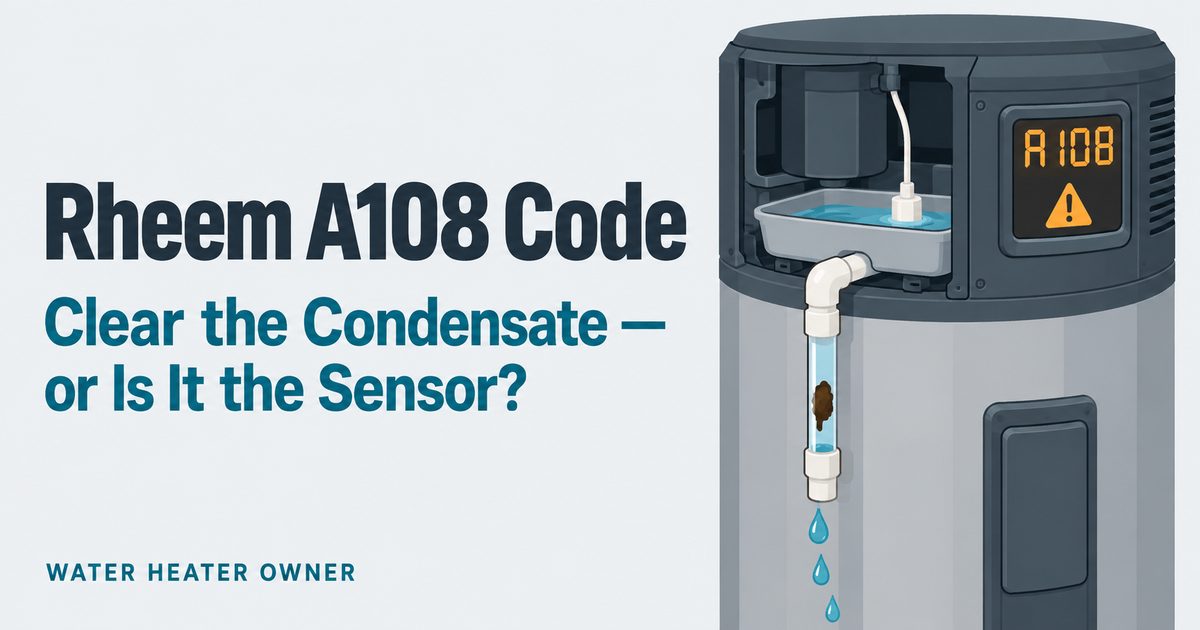
A108 means the condensate rope sensor inside your Rheem hybrid is wet, because the condensate the heat pump produces isn’t draining the way it should. It isn’t an anode problem, and the control board is the least likely cause. Work it in Rheem’s order: find where the condensate goes and clear the line, dry the sensor and pan (the sensor can stay unplugged 24–48 hours to dry), and only suspect the board if the code still comes back after both.
That order comes from Rheem’s tech bulletins: TB 1333 has you check the condensate route and line before you look at the sensor, and TB 1332 ranks a clogged condensate line or pan as the most likely cause, a faulty rope sensor second, and a bad control board as the least likely — but still possible. I’m not a plumber or an electrician; everything below comes from the bulletins and the Gen V manual, and it’s checking, not rewiring.
What does the A108 code mean?
Your hybrid’s heat pump pulls warm, humid air across a cold evaporator coil and squeezes water out of it — condensate. In normal operation it drips into a pan, out a drain port, and away down a PVC line. Rheem’s TB 1332 explains the alarm side: a “condensate rope sensor” sits in that drain path — below the fan filter, in the heat pump section — wired to the controller. If the line clogs or gets restricted, condensate backs up, touches the rope, and the unit starts beeping A108 “Condensate Blocked” at you.
So the sensor isn’t broken when A108 fires — it’s doing its job. The alarm means “I’m wet,” and the real question is why the water is there. Many owners on the forums assume A108 means a dead anode or a fried board and start shopping for parts — the expensive way around a one-line diagnosis.
And while A108 is active, the heater stops using the heat pump and falls back to the electric elements — the Gen V owner’s manual describes the heating source defaulting to elements due to the blockage. An ignored A108 is likely to show up on your electric bill; this code costs you money while it waits.
Before touching anything: clear the alarm from the panel and cut power to the water heater at the breaker, and keep it off while you work. That’s not me being cautious — it’s literally the pre-troubleshooting step in TB 1332, and this is a 208–240V appliance.
Step 1 — Find where the condensate goes and clear the line
This is the actual cause behind most A108 alarms — TB 1332 ranks a clogged or restricted condensate drain line or pan as the most probable cause of the code, and both bulletins start here. Condensate lines grow algae and collect gunk, and they only need a partial restriction for water to back up faster than it drains.
Start where TB 1333 starts: figure out where your condensate actually goes. The bulletin just says to ask; the practical follow-up is to trace the PVC line from the unit — floor drain, utility sink, outside, condensate pump — and look for the obvious: sags, kinks, a crushed section, a dead pump, a blocked outlet.
For the clog itself, TB 1332 has you disconnect the PVC line from the drain pan port, examine it, and flush it out if needed. To get at the pan, the bulletin describes removing the lid — four screws around it and four on top — with the pan sitting in the heat pump section below the filter. Clean and dry the pan while you’re there. Work gently around the rope sensor; you’re trying to clear a drain, not yank a wire out of its pocket.
Step 2 — Dry the rope sensor and the pan
Even once the line runs clear, the rope can still be damp — and a damp rope keeps the alarm alive after the actual blockage is gone.
With power still off at the breaker, pull the top cover or the air filter (the same filter you should be cleaning anyway) and look down into the opening at the condensate pan. Rheem’s TB 1333 walks through exactly this: check whether there’s excess condensate sitting in the pan or on the sensor, and if there’s water, dry the sensor and the pan with a paper towel or cloth. The bulletin also pins down where the rope should actually sit — in a pocket below the evaporator coil, above the drain pan — so while you’re in there, confirm it’s seated in that spot and that the pocket is dry, not draped somewhere it’ll catch drips.
The rope may need real time to dry out: TB 1333 says the sensor can be left unplugged for 24 to 48 hours to dry. (The 24-hour run with the sensor disconnected in TB 1332 is a different thing — a diagnostic test, covered in Step 3.) Per TB 1333, the unit will still operate with the sensor unplugged, so you’re not going without hot water while it dries — but for that window nothing is watching for backed-up condensate. Reaching the sensor’s plug means taking the controller off the front of the unit (see Step 3), so do it with the breaker off.
Many owners report that a wet rope was the whole story — the beeping stops once the rope is dry. If the pan and sensor are dry and you find no obstruction anywhere — TB 1332’s words, roughly — then and only then does suspicion move to the sensor itself or the control board.
Step 3 — When it’s the sensor or the control board
Say you’ve cleared the line, dried everything, and A108 still comes back. Now the diagnosis gets more surgical, and TB 1333 lays out the two checks in order.
Both checks mean taking the controller off the front of the unit — TB 1332 describes prying the face plate off and removing two screws. Rheem’s manual tells owners not to attempt repairs to electrical wiring or electronic controls and to refer them to qualified service personnel, so this step belongs to a technician. Here’s what they’ll check, so you know what you’re paying for.
First, the sensor. A dry rope sensor should read “open” on an ohmmeter — no continuity at all. TB 1333 is blunt about it: if the sensor shows any continuity while dry (measured on the meter’s highest resistance scale), the sensor is bad and gets replaced. A rope that “leaks” electrically reads as wet forever, no matter how dry the pan is. TB 1332 adds a useful clue: on a new install, it points first at the rope sensor — and, on its troubleshooting page, the controller — rather than a clogged line.
Then, and only then, the board. TB 1333’s last step: unplug the sensor from the control board — the bulletin describes the small connector with two grey wires, but wire colors can differ by generation (the Gen V wiring diagram labels this lead “CONDENSATE”), so go by the label, not the color — and run the unit for 24 to 48 hours. No sensor plugged in means nothing can report “wet.” So if A108 still comes back with the sensor disconnected, the fault is on the board itself, and the bulletin’s verdict is to replace the PCB.
The bulletins don’t list part numbers, but the Gen V manual’s replacement-parts table does: a condensate water sensor (AP17940-1 or AP20946) and the controller assembly (AP22944). Confirm the right one for your model and serial number with Rheem support (1-800-432-8373) before ordering. Replacing a control board is work the manual reserves for qualified service personnel, not an owner. And the point of steps 1 and 2 is that the board is the last suspect, not the first — a board swapped first won’t fix a clogged line.
Why it keeps coming back
Given TB 1332’s ranking, a repeat A108 every few weeks points first at a marginal drain, not a haunted sensor. Three things to check:
- Slope. Rheem’s manual says all drain lines must be pitched downward, away from the unit, at least 1/8 inch per foot. A flat or back-sloped run holds standing water, and standing water grows the algae that clogs it.
- The line itself. A warm, damp tube will grow stuff over time. The Gen V manual’s routine: at least once a year, pour a cup of bleach into the access opening of the condensate drain to kill algae, mold, or mildew, and make sure the condensate flows freely — beats meeting the clog through the alarm. While you’re at it, keep the air filter clean too.
- No gravity path? If there’s no floor drain and no honest downhill slope to be had, the manual requires a condensate pump with a capacity of at least 2 gallons per day — a small reservoir pump that pushes the water up and out to a drain.
One caution from the manual: never connect the T&P discharge to the condensate plumbing. The T&P line has to run directly to a suitable open drain on its own.
One neighbor code so you don’t chase the wrong fix: A107 (“Water Detected on Floor”) comes from a different sensor — the leak rope sensor, not the condensate sensor behind A108 (the Gen V wiring diagram shows them as separate inputs). The manual’s cause for A107 is water detected in the drain pan, its first step is checking for an actual leak, and it can be overridden for 24 hours by holding Clear Alarm for 5 seconds. A107 means look for a leak, not a clog. The full list is in the error codes guide.
FAQ
Can I just unplug it to reset A108?
Power-cycling isn’t a fix Rheem lists — the bulletins have you clear the alarm and then find the water, and a wet rope or a blocked line is still there after a restart. What you can do, per TB 1333, is unplug the sensor itself at the board (breaker off first) — the unit will still operate without it, which is how you dry the sensor for 24–48 hours or test the board. Treat that as a diagnostic window, not a permanent fix: with the sensor unplugged, nothing is watching your condensate.
Is A108 dangerous? Can I keep using hot water?
In my view it’s not a safety emergency: the manual says the heater defaults to the electric elements, so you’ll still get hot water. The catch: you’re paying resistance rates until it’s fixed, and if the blockage stays, backed-up condensate can eventually overflow the pan. Fix it soon, not tonight at 2 a.m.
How much is a new control board?
Rheem’s bulletins and the Gen V manual don’t publish prices for the board or the rope sensor, so any figure I gave you would be a guess. Call Rheem support with your model and serial number, and ask whether it’s under warranty. More importantly, TB 1332 ranks the board as the least likely cause of A108: rule out the line and the sensor before anyone sells you one.

Dan Mercer — Dan Mercer is the pen name of Water Heater Owner’s editor. I’m not a licensed plumber or electrician, and I don’t sell or install water heaters. Every guide here starts from the manufacturers’ manuals and technical bulletins, is cross-checked against what owners consistently report, and says which is which — including what you can safely check yourself and when it’s a job for a licensed plumber or electrician.