Heat Pump Water Heater Condensate: Drain or Pump?
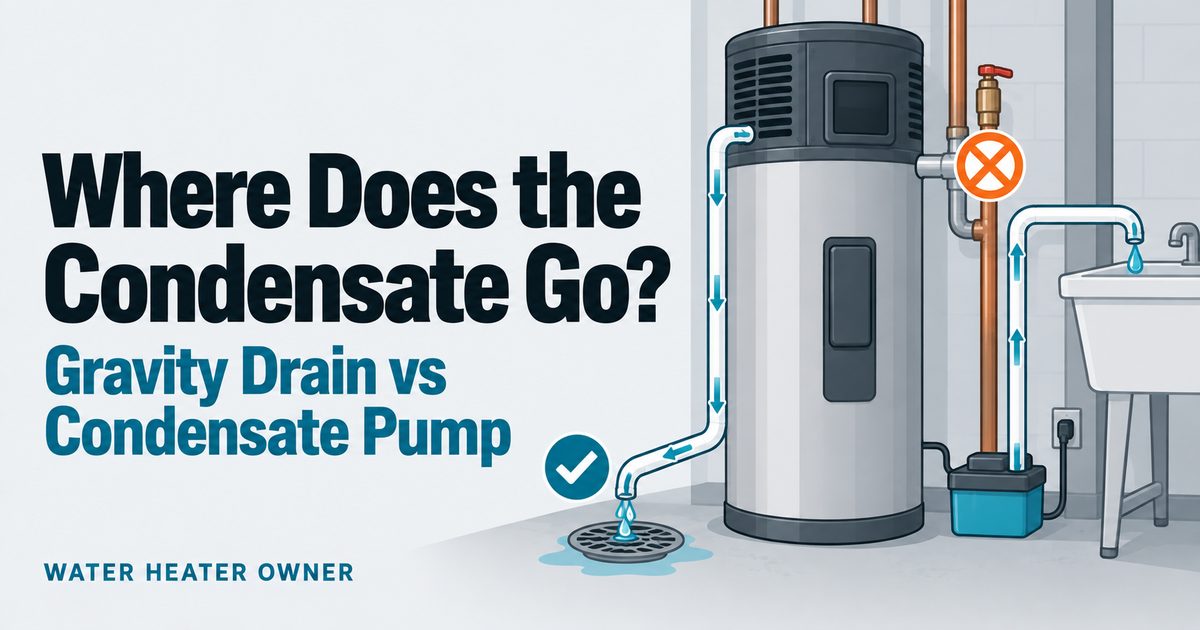
A heat pump water heater dehumidifies the air it runs on, and that water — condensate — has to leave the machine every day it operates. You have three exits, in order of preference: gravity to a floor drain or utility sink, a condensate pump when there’s no drain within reach, or outside where climate and local code allow it. Never tee it into the T&P discharge line. Plan this badly and you’ll meet the A108 alarm later.
Why a heat pump water heater makes water at all
The heat pump half of your hybrid pulls warm, humid air across a cold evaporator coil. Heat goes into the tank; the humidity condenses on the coil, drips into a pan, and runs out a drain port into a line. Your water heater is also a small dehumidifier, and unlike a regular electric tank it produces water as a normal byproduct of doing its job.
Two useful facts about that water. It’s clean, not the acidic stuff a condensing gas furnace makes — Rheem’s Gen V owner’s manual says explicitly it needs no neutralization. And the unit is watching it: on a Rheem, condensate that backs up wets a rope sensor and fires A108, and the heater falls back to the electric elements until it’s fixed. A drain improvised on install day becomes an alarm — and a bigger electric bill — a season later.
When Rheem’s own technicians troubleshoot a condensate alarm, the tech bulletin’s first step is asking where the condensate is routed — somewhere that satisfies local or national code. Where the water goes is literally the first question on the service sheet. So let’s answer it properly.
Option 1 — Gravity to a drain
If there’s a floor drain or a utility sink near the unit, this is the setup you want: no moving parts, nothing to fail, nothing to plug in.
The requirements are modest but non-negotiable. Rheem’s Gen V manual specs the condensate connection as a 3/4” NPT female fitting and calls for the drain line to fall at least 1/8 inch per foot, continuously, all the way to the drain. Continuous is the key word — one sag or back-sloped section holds standing water, standing water grows algae, and algae is how a two-dollar length of PVC turns into a beeping alarm.
Two more details. End the line above the drain with an air gap rather than shoving it down into the pipe — standard practice, because a submerged or sealed end can siphon or back-feed. And if the line runs to a sewer connection, Rheem’s manual requires a P-trap in the condensate line so you’re not smelling drain gas through your water heater. The forums host long arguments about traps and vents on gravity lines; when in doubt, the manual and your local inspector outrank the forum.
How close does the drain need to be? No single number appears in the owner documentation I have — the “within about 36 inches” figure you’ll see around is a common installer and pump-vendor recommendation, not a code citation. If the drain is across the room and uphill, you’re really in Option 2 territory.
Option 2 — A condensate pump
No floor drain, or the only drain sits higher than the unit’s outlet? That’s what a condensate pump is for — a small reservoir with a float switch that pushes the water up and over to a sink, standpipe, or drain line. A.O. Smith’s service handbook for its PHPT hybrids is direct about when you need one: whenever the drain sits above the water heater’s drain connection, gravity is out and the pump is in. Rheem’s Gen V manual sizes it: if no drain is available, use a condensate pump rated for at least 2 gallons per day. Basic units run about $50–90, and any pump sold for furnace or AC condensate duty clears that bar easily.
Here’s the part almost nobody tells you, and it explains some confusing alarms. On the A.O. Smith/State PHPT platform, the accessory pump isn’t just plugged in next to the heater — the service handbook wires the pump’s failure detection into the control, and if the pump can’t evacuate water, the control shuts the heat pump down so it stops producing condensate. The display shows “HEAT PUMP FAULT,” with “CONDENSATE DRAIN ALARM” behind it in the maintenance display. The Voltex owner’s manual from the same company walks the same alarm: pump plugged in and powered, breaker and GFCI, outlet tube clear, control cable connected — and only then replace the pump. That’s platform-specific wiring; I have no Rheem document describing the same interlock, so don’t assume your ProTerra behaves that way. But the lesson travels: a dead $60 pump can present as a “broken” $1,800 water heater. When a hybrid with a pump throws a heat-pump or condensate fault, check the pump before you call anyone.
Option 3 — Outside
Running the line through the wall and letting it drip outside is legitimate in some places and prohibited in others — this one is entirely a local code question, so ask your inspector or a licensed plumber before you drill. I’m not a plumber, and code varies too much here for anyone’s blog to be your authority, mine included.
Where it is allowed, think about where the water lands: away from the foundation, not onto a walkway that ices over, and pitched so the line drains empty. The killer for outdoor terminations is winter — condensate that freezes at the outlet is a blocked line, and a blocked line is an A108. If your unit lives in an unconditioned space, that pairs with the bigger question of how hybrids handle winter at all — see running one in a cold garage.
The mistakes that cause A108 later
Most condensate alarms are born on installation day. The recurring mistakes:
- Teeing into the T&P discharge line. The temperature and pressure relief line is a safety device and it stays dedicated — nothing shares it, restricts it, or caps it. Ever. It’s the one line on the heater that exists for the day something goes wrong.
- Tying into the sewer without a trap or air gap. Sewer gas migrates up untrapped lines, and a backed-up drain can push water the wrong way — Rheem’s P-trap requirement for sewer connections exists for a reason.
- Draining into the unit’s own drain pan. The safety pan under the heater catches emergencies; Rheem’s manual says not to route the condensate line into it. A pan holding water every day defeats its purpose — and on a hybrid it can look exactly like a leak.
- No slope, or almost-slope. A flat run “works” for months, quietly growing algae in the standing water, then clogs.
- A long run nobody can clean. Condensate lines are warm and damp — stuff grows in them. Rheem’s manual has you pour a cup of bleach into the drain access once a year to keep algae and mold down. If your line has no way to flush it, you’ll eventually meet the clog through the alarm codes instead.
FAQ
Can the condensate just drain into a bucket?
As a diagnostic for a day, nobody will arrest you. As an installation, no — Rheem’s own troubleshooting starts by verifying the condensate goes somewhere that satisfies local or national code, and a bucket isn’t that. The practical problem gets you first anyway: buckets fill, overflow wicks back, the rope sensor gets wet, and the beeping starts.
How much water does a heat pump water heater make per day?
It depends heavily on humidity and how long the compressor runs. The one hard number I can cite: A.O. Smith’s service handbook for its PHPT hybrids says the unit can produce more than 20 ounces per hour of runtime in high-humidity conditions. Owners typically report somewhere between a quart and a gallon or so on a normal day, more in a muggy summer basement — treat those as reported ranges, not specs. Either way it’s enough that “it’ll just evaporate” is not a drainage plan.
Does a condensate pump need its own outlet or a GFCI?
The pump plugs into a standard receptacle, and the manufacturers assume it’s a live, protected one — A.O. Smith’s Voltex manual has you check the breaker and the GFCI first when the condensate alarm fires. Whether that outlet must be GFCI-protected in your utility room is a local electrical code question. If there’s no outlet near the unit, that’s a licensed electrician’s job, not an extension cord’s.

Dan Mercer — Dan Mercer is the pen name of Water Heater Owner’s editor. I’m not a licensed plumber or electrician, and I don’t sell or install water heaters. Every guide here starts from the manufacturers’ manuals and technical bulletins, is cross-checked against what owners consistently report, and says which is which — including what you can safely check yourself and when it’s a job for a licensed plumber or electrician.