Water Under Your Heat Pump Water Heater? Triage It Fast
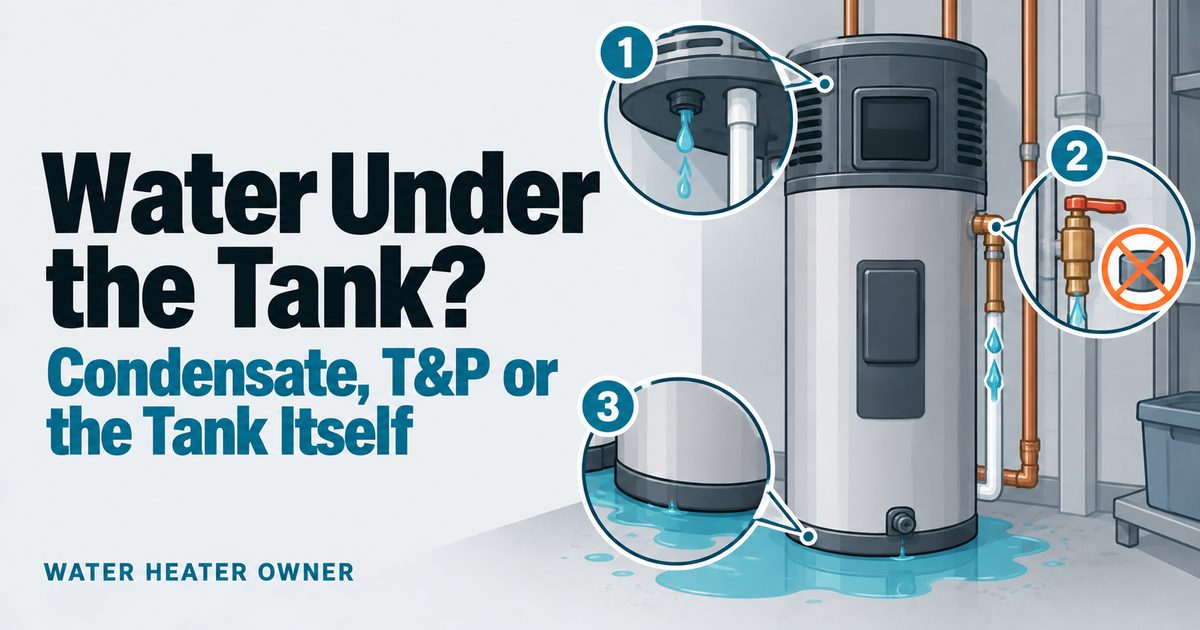
Water under a hybrid water heater is usually condensate that stopped draining — the cheapest problem the unit can have — not a failing tank. Trace the puddle top-down: the condensate pan and line first, then the hot and cold fittings, then the T&P relief valve (a drip there is a symptom — never, ever plug it), and the tank itself last. Only the corroded tank means replacement.
First: where is the water actually coming from?
Safety first: this is a 240V appliance. If water has pooled around the base or reached any wiring or the electrical cover, turn the heater off at the breaker before you touch or mop anything, and don’t stand in water to reach the panel — if you can’t get to the breaker without doing that, call an electrician or plumber.
A puddle tells you almost nothing by itself — water runs downhill along the jacket and pools wherever the floor dips. So before deciding anything, dry everything with towels, restore power once the area is dry, run the unit, and watch where the first drop reappears. Ten minutes of looking beats a thousand dollars of guessing.
A hybrid has four places water can come from, top to bottom:
- The condensate pan and drain line — up in the heat pump section. The unit manufactures water every day; if the drain clogs, it overflows.
- The plumbing connections — hot and cold fittings on top, plus any unions or flex connectors.
- The T&P relief valve — its discharge tube usually ends near the floor, so a discharging valve looks like a floor-level leak.
- The tank itself — water seeping from under the jacket at the base, with everything above it dry.
That first suspect is what makes a hybrid different. A standard electric tank has no condensate system, so “water on the floor” traditionally meant bad news. On a heat pump water heater, the most likely source is also the most fixable one — the panic in owner threads (“puddle = tank’s dead, start pricing replacements”) is usually wrong for this machine.
Your heater may even tell you outright. Rheem’s Gen V hybrids have a rope sensor in the drain pan and dedicated alarms for exactly this — A107 “Water Detected on Floor” and A108 “Condensate Blocked.” A.O. Smith’s 2012 Voltex, when it has the accessory condensate pump, shows “CONDENSATE DRAIN ALARM” if the pump fails; the 2019 Voltex flags condensate trouble as EoF. If the display is beeping at you, start with the error codes guide — the code often names the source before you’ve picked up a towel.
Suspect #1 in a hybrid: condensate
The heat pump pulls humid air across a cold coil; the water condenses, drips into a pan, and drains out a line. If the line clogs, sags, or was never plumbed right, the pan overflows and you get a slow, recurring puddle — often worse on humid days, which is a giveaway in itself: a leak doesn’t care about the weather, but condensate production does.
A.O. Smith’s Voltex installation checklist has a detail worth stealing for diagnosis: water coming out of the plastic shroud means both condensate drain lines are blocked and needs immediate action. Water appearing from the heat pump housing itself, up top, is condensate by definition — the tank doesn’t reach up there.
On a Rheem, the machine narrates the problem. Per the Gen V owner’s manual, A107 means the rope sensor found water in the drain pan — look for the leak, and the alarm can be overridden for 24 hours by holding Clear Alarm for 5 seconds while you sort it out. A108 means the condensate line itself is blocked, and the heater falls back to the electric elements — quietly costing you money — until it’s cleared. Either way the fix is the same unglamorous plumbing: find the clog, clear the line, dry the pan — the full procedure is in the A108 walkthrough. And if the puddle traces back to a drain that was never set up right, fix the setup itself — gravity, pump, or outside — or you’ll be back here every few weeks.
Suspect #2: fittings and connections
If the top of the unit is wet around the hot or cold water connections, you’ve found it — water runs from those fittings down the jacket and pools underneath, doing a convincing impression of a tank leak. Look closely at threaded joints, flex connector nuts, and any shutoff valve above the heater.
A compression nut that’s weeping can sometimes be snugged gently — emphasis on gently, because overtightening cracks fittings and turns a drip into a spray. That’s the entire extent of my wrench advice: I’m not a plumber, and anything beyond a quarter-turn snug — sweating joints, replacing a flex line, a fitting that keeps weeping — is a licensed plumber’s call. The good news: this category is routine service, not a dying water heater.
The T&P valve is dripping
The temperature and pressure relief valve is the one component you treat with respect. Its job is to open and let water out if temperature or pressure climbs too high — Rheem’s Gen V manual rates the relief at up to 150 PSI. A dripping T&P valve is a message, not a malfunction — and the message is usually about pressure.
The common cause is thermal expansion: water expands as it heats, and in a “closed” plumbing system (a check valve or pressure regulator at the meter) that extra volume has nowhere to go, so pressure spikes and the valve burps a little water after heating cycles. Both Rheem’s Gen V manual and A.O. Smith’s Voltex instructions address thermal expansion in their installation sections, and the standard remedy is an expansion tank — a small air-cushion tank that absorbs the spike. Diagnosing and installing that is plumber territory; it involves your home’s pressure, not just the heater.
What you never do — and I mean never — is cap, plug, or “fix” a dripping T&P valve by stopping the drip. That valve is the last line of defense against a tank over-pressurizing, and blocking it converts a nuisance into a genuine hazard. If it discharges continuously or in real volume rather than an occasional dribble, stop reading blogs and call a licensed plumber promptly.
Water from the tank itself
The one you were afraid of. If pan, line, fittings, and T&P tube are all dry and water still seeps from under the jacket at the base — slow, steady, no visible source — the likely story is a corroded tank. A corroded tank isn’t repaired; it’s replaced.
Steel tanks last as long as they do because the anode rod sacrifices itself to corrosion in the tank’s place — the same component behind the rotten egg smell issue, and your biggest lever over tank lifespan. A tank never flushed and never given a fresh anode simply gets there sooner.
If you conclude it’s the tank: cut power at the breaker, close the cold water shutoff above the heater, and call a plumber. A 240V appliance and standing water are no combination to improvise around — kill the breaker before you mop underneath it. Most tank leaks seep rather than burst, but 50 gallons on a failing shell isn’t something to schedule casually either.
Leak sensors and auto-shutoff
The newer machines assume this whole article will happen to you eventually, and try to limit the damage.
Some Rheem Gen V models include an automatic water shutoff valve — the LeakGuard system — and per the manual it runs a self-check every 30 days. The alarm list carries dedicated codes for that valve (A120–A123) plus one for a leak sensor that isn’t installed — which tells you these are equipment options, not universal features. Your manual and model number settle whether yours has them.
GE’s relaunched Profile GeoSpring (the 2025-and-later generation) has its own pair, per GE Appliances’ support documentation: F78 means the leak sensor detected water — find and fix the leak, then reset the shutoff valve if the unit has one — and F81 just means the leak sensor’s battery is low. Don’t map those onto the old 2012–2016 GeoSpring — different machine, different code family.
The workflow is the same with any of them: fix the actual source first, then rearm the valve or sensor per your owner’s manual — resetting the alarm without finding the water is just muting the smoke detector.
FAQ
Is a leaking water heater an emergency?
It depends on the source. Condensate: no — fix it soon, because you’re likely running on the electric elements meanwhile, but nobody floods from a clogged drain line overnight. A weeping fitting: minor; watch it, plumber if it persists. A T&P valve discharging continuously: urgent — plumber, and never plug it. A seeping tank: act the same day — breaker off, water off, plumber called — even though most tanks fail with a seep, not a bang.
Can I keep using hot water while I figure it out?
Usually, yes. A condensate problem doesn’t touch the pressurized water system at all — on a Rheem with an active A108 you’ll have hot water via the electric elements, just at a higher running cost. Same for a minor fitting drip. The exceptions: a tank leaking from the shell should be shut down, and a T&P valve in continuous discharge means something is over-limit — get a plumber on it first.
How long does a heat pump water heater last?
The federal energy.gov guidance puts a typical storage water heater at roughly 10–15 years, and that’s the planning number most owners use for hybrids too — the tank half is the same steel-tank story. Treat it as a rough range, not a warranty: water chemistry, pressure, and whether anyone ever minded the anode move individual units a lot in both directions.

Dan Mercer — Dan Mercer is the pen name of Water Heater Owner’s editor. I’m not a licensed plumber or electrician, and I don’t sell or install water heaters. Every guide here starts from the manufacturers’ manuals and technical bulletins, is cross-checked against what owners consistently report, and says which is which — including what you can safely check yourself and when it’s a job for a licensed plumber or electrician.