Vacation Mode on a Heat Pump Water Heater: Use It Right
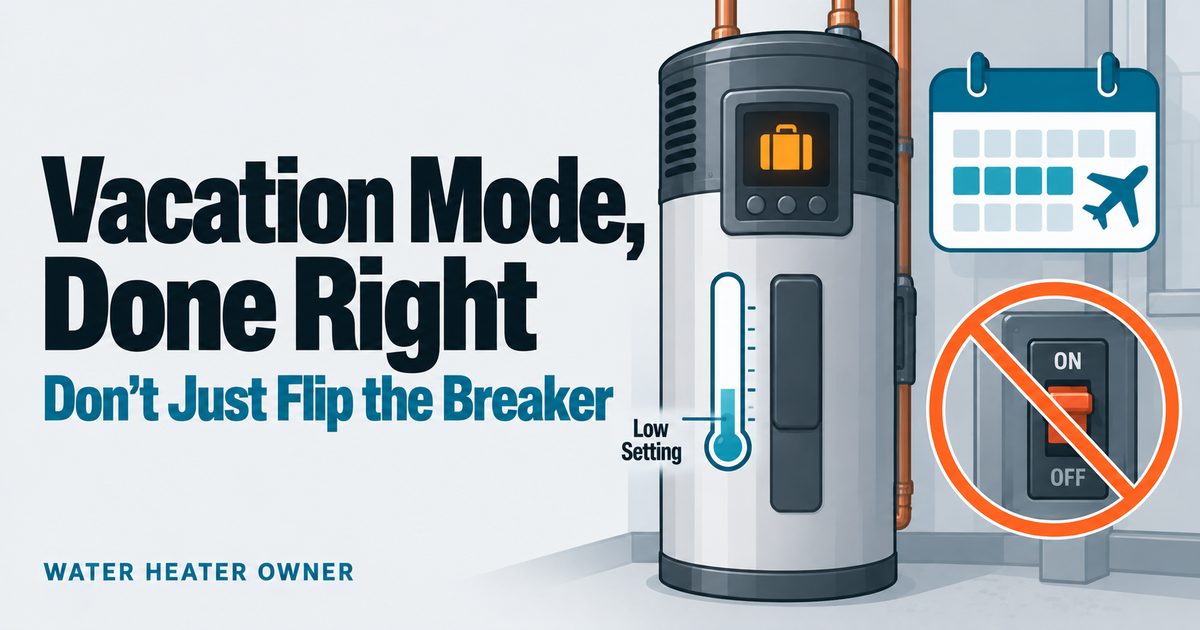
Use Vacation mode, not the breaker. On a Rheem Gen V hybrid, Vacation holds the tank at roughly 82 °F for a period you set — 2 to 28 days, or “Hold” indefinitely — using the compressor only as needed. That costs very little, and it sidesteps the real problems with cutting power: powered anodes that stop protecting the tank without electricity, freeze exposure in cold spaces, and coming home to a stone-cold restart.
The instinct to flip the breaker before a trip comes from the gas-tank era, and most “turn off your water heater on vacation” articles are still written for that world. A hybrid has a mode built for exactly this — and, depending on the brand, a very specific reason not to go dark. The Rheem details here come from the Gen V “Universal Connect” Use & Care Manual (AP23657), the same source behind my guide to all five modes.
What Vacation mode actually does
On the Rheem Gen V, Vacation mode drops the target temperature to about 82 °F and keeps the tank there using the compressor as needed — no electric elements, no attempt at recovery (the manual’s comparison table rates its recovery “None”) (pp. 22, 24).
That 82 °F number is the clever part. It’s not “off”: the tank never goes cold, which keeps it away from freezing and means reheating on your return starts from lukewarm, not ground zero. And it’s not “on” either: holding 82 °F instead of 120 °F takes only occasional, cheap compressor cycles. Most of the savings of shutting down, none of the downsides.
The scheduling is the detail owners miss: you set Vacation for 2 to 28 days, or select Hold to keep it there until you cancel it (p. 22). Set the day count to end when you’re due home and the heater comes off Vacation on its own — owners on GreenBuildingAdvisor describe exactly this, the unit sitting low for the days configured and then resuming. Time it right and you walk in to hot (or nearly hot) water instead of waiting out a full reheat.
Away vs. Vacation — the EcoNet confusion
If you use the EcoNet app, you’ve noticed it offers an “Away” setting while the front panel calls its mode “Vacation” — and if that’s confused you, you’re in good company. Threads on GreenBuildingAdvisor show ProTerra owners — technically fluent people — asking whether the app’s Away toggle and the panel’s Vacation mode are the same thing, without a crisp answer. Rheem doesn’t document the app’s behavior in the Use & Care manual at all.
My practical advice: set Vacation from the front panel, with a day count. That’s the mode the manual defines — 82 °F, 2–28 days or Hold (p. 22) — so you know exactly what you’re getting, and the timer self-cancels even if you never open the app again. Treat the app’s Away toggle as a remote convenience; if you do use it, verify afterward that the displayed setpoint actually dropped.
Why not just flip the breaker?
Because for some hybrids, power is the corrosion protection.
Conventional tanks use a sacrificial anode rod — a metal stick that corrodes on purpose so the tank doesn’t. But some hybrids, notably A.O. Smith’s 2012-generation Voltex and its State-branded PHPT siblings, use a powered anode instead (the 2019 Voltex uses a sacrificial rod): a titanium rod fed a small voltage by the control board, which is what stops the tank wall from corroding. No electricity, no protection. A.O. Smith’s service documentation for its hybrid platform is blunt about the consequence: the anode requires power to operate, power should not be cut for a prolonged period, and if it must be, the tank should be drained completely to minimize corrosion (service handbook 321547-000, pp. 8, 27). The same logic reasonably extends to the aftermarket powered anode rods people install to fight rotten egg smell — those need power too.
For fairness: the Rheem Gen V uses a traditional sacrificial anode (AP23657, p. 29), so a few dark weeks won’t hurt a Rheem tank on that front. But the breaker still buys you problems it doesn’t need to:
- Freezing. A powered-off tank in a cold garage during a cold snap is on its own. Running, the Rheem at least has a dedicated freeze-warning alarm (A130, p. 33), and Vacation’s 82 °F hold keeps the water far from trouble. Powered off, nobody’s watching. If your heater sits in a cold space, read the cold garage guide before winter travel either way.
- The cold restart. You come home to an 80-gallon tank of cold water and a compressor whose cheap heat is also slow heat. That first evening is showers-by-appointment.
- Stagnation. A.O. Smith’s Voltex manual warns that hydrogen gas can build up in a water heater unused for two weeks or more, and says to open a hot faucet for a few minutes before running any appliance on the hot line (318257-002, p. 2). That applies whether or not you cut power — make it your coming-home routine after any long trip.
So the decision tree is short. Normal trip: Vacation mode, power on. Genuinely prolonged shutdown — a house left for a season, a powered-anode unit you can’t keep energized — follow the manufacturer’s precaution and have the tank drained first. If draining a pressurized tank isn’t something you’ve done, that’s a plumber visit, not a guess.
Other brands, briefly
A.O. Smith Voltex: the 2012-generation Use & Care manual defines Vacation mode as holding the water at about 60 °F — pitched as minimum energy use plus freeze protection (318257-002, p. 14). Note the vintage: A.O. Smith’s current hybrid manual (100379659, March 2025) fixes Vacation at 50 °F, so check the manual for your production year. Different hold points — 50-60 °F versus Rheem’s 82 °F — but the same philosophy: warm enough to be safe, cool enough to cost almost nothing.
GE GeoSpring: vacation-type settings exist but vary by generation, and GeoSpring is an orphaned brand with split support — check the manual for your specific vintage.
The pre-trip 60 seconds
The whole ritual, the night before you leave:
- On the front panel, select Vacation and set the days to end when you come home (2–28 days; Hold if the return date is open) (p. 22).
- Confirm the display actually shows Vacation — not just a lower setpoint you’ll forget about.
- Leave the breaker on. That’s the whole point.
- Back home: cancel Hold if you used it, and run a hot tap for a couple of minutes before any appliance (the hydrogen precaution above).
Sixty seconds, no cold homecoming, and every protective system in the unit stays awake while you’re gone.
FAQ
Does Vacation mode actually save much?
It saves real money for zero sacrifice — but I won’t pretend there’s a published dollar figure, because there isn’t. What the manual supports is the mechanism: holding 82 °F on occasional compressor cycles is a fraction of the energy of holding 120 °F ready-to-shower all week (pp. 22, 24). On a machine that’s already cheap to run, expect a modest absolute saving — the stronger arguments are the freeze protection and the anode. For where the real money goes, see what these units actually cost to run.
Can I set it from the EcoNet app?
The app offers an Away control, and owners do use it — but the manual only documents the panel’s Vacation mode, and forum threads show even experienced owners unsure how the two relate. Set it at the panel with a day count; use the app to monitor. Belt, then suspenders.
What if my trip runs long?
That’s what Hold is for: instead of a day count, Hold keeps Vacation active until you cancel it (p. 22). And if you set 14 days and day 15 happens, no harm — the unit just resumes normal heating in an empty house until you’re back. Annoying, not dangerous. If your return dates are habitually fuzzy, use Hold and cancel it when you walk in — or from the app on the drive home.

Dan Mercer — Dan Mercer is the pen name of Water Heater Owner’s editor. I’m not a licensed plumber or electrician, and I don’t sell or install water heaters. Every guide here starts from the manufacturers’ manuals and technical bulletins, is cross-checked against what owners consistently report, and says which is which — including what you can safely check yourself and when it’s a job for a licensed plumber or electrician.