Heat Pump Water Heater Runs Out of Hot Water? 4 Levers
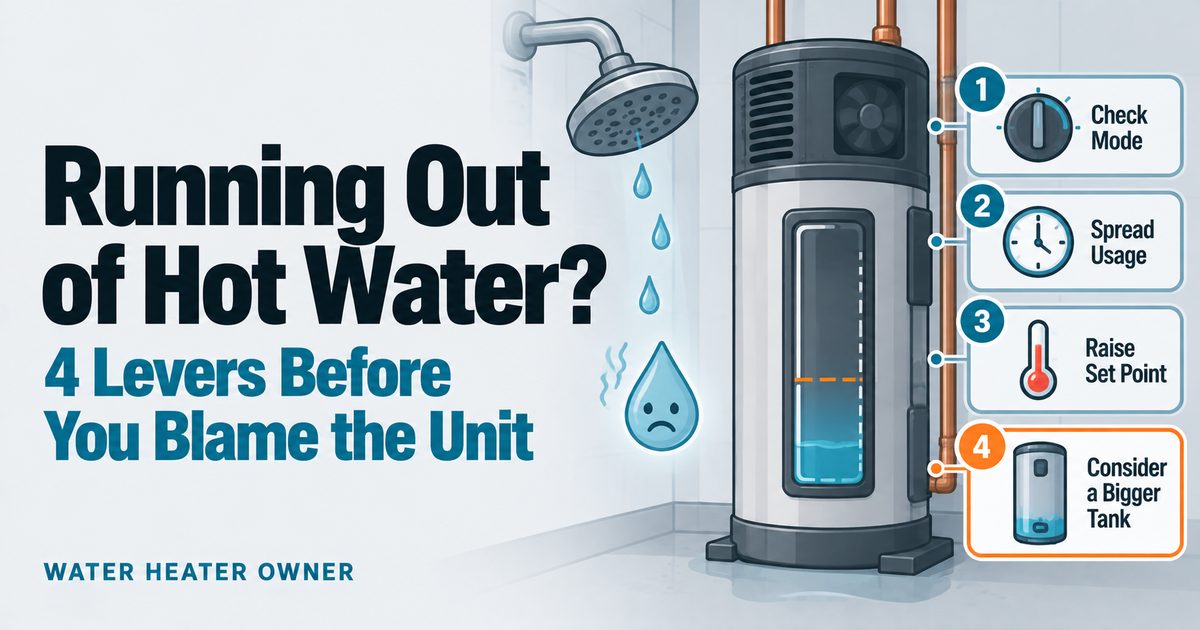
If your heat pump water heater keeps running out of hot water, it’s probably not broken — it’s the design. The compressor makes hot water slowly and cheaply; the backup elements make it fast and expensively. Before you blame the unit or shop for a bigger one, work four levers in order of cost: the mode (High Demand exists exactly for heavy days), spacing your big draws, the setpoint, and only then tank size.
I lead with that because it’s one of the most common misconceptions in new-owner threads: the tank runs cold on a busy morning, and the conclusion is “this thing is defective.” Almost always, nothing is wrong — the slow reheat is a deliberate trade printed in the manual. As usual, the specifics come from the Rheem Gen V “Universal Connect” Use & Care Manual (AP23657) — the unit behind my full guide to the five modes — but the logic carries across brands: A.O. Smith’s Voltex manual describes the same compressor-first, elements-on-demand design.
Why a hybrid recovers slower than your old tank
A conventional electric water heater reheats with resistance elements — the Rheem’s parts list shows them at 2.25 and 4.5 kW (p. 39). That’s raw electric power dumped straight into the water: quick, and priced accordingly.
The compressor is a different machine: it doesn’t generate heat, it moves heat from the surrounding air into the tank, drawing only a few hundred watts. For scale, A.O. Smith’s service handbook for its first-generation hybrid platform lists that unit’s compressor at 850 watts — a different brand, but the ratio is representative. Several times less power in means several times less heat per hour; your modest electricity bill and your slow recovery are the same fact. Rheem says so in its own mode comparison: Heat Pump, the compressor-only mode, is rated “Very Slow” for recovery (p. 24). Slow recovery isn’t a symptom — it’s the product working. So: four levers, cheapest first.
Lever 1 — Pick the right mode for the week you’re having
This is the free lever, and the one most owners never touch.
If you’re running short and the unit is in Heat Pump mode, start there. It’s the cheapest mode and the only one that “will not use any electric heat during typical heating and demand cycles” (p. 22) — and that discipline is exactly why it recovers slowest. Fine for steady, spread-out usage; wrong for a house full of guests. Energy Saver — the factory default — is the balanced setting: the compressor does the primary heating, “with one heating element engaging only if required by demand” (p. 24). Most households with occasional shortfalls fix them just by moving from Heat Pump back to Energy Saver.
And then there’s the lever Rheem built for precisely this complaint: High Demand runs the compressor and the electric elements at the same time (p. 22). The manual rates its recovery “Very Fast” and its efficiency “Low” (p. 24) — you pay more per gallon while it’s on, on purpose. A terrible permanent setting, a perfect temporary one: in-laws visiting, teenagers showering back to back, a holiday weekend. Switch it on for the heavy days, switch it back after; mode changes are ordinary owner-facing controls. The full cost-versus-speed breakdown of all five modes is in the modes guide.
Lever 2 — Space out the big draws
Still free, and it’s the standard advice in every forum thread on this problem — owners on Reddit and TractorByNet keep giving the same answer: don’t stack your hot-water hits. A slow-recovering compressor handles a marathon fine; it’s the sprint that beats it. Two showers, the dishwasher and a hot laundry load inside one hour will drain any mid-size tank faster than a heat pump can climb back; the same usage spread across the morning may never run cold. So run the appliances outside the shower window (overnight, if your rates reward it) and separate colliding showers by an hour when you can. Unglamorous, costs nothing, and for a lot of households it’s the whole fix.
Lever 3 — The setpoint trade-off
Raising the setpoint doesn’t make the tank bigger, but it does something close: hotter water gets diluted with more cold at the tap, so each stored gallon stretches further into more total shower-minutes. Two serious caveats before you touch it.
Scalding is the real risk. The Rheem ships at 120 °F (p. 3) — the long-standing public safety reference for household hot water — and the manual’s scald warning appears at settings of 120 °F and above, with a time-to-burn table up front for exactly this reason (pp. 3, 23). Rheem gates settings above 140 °F behind a deliberate button-hold (p. 23): that territory is genuinely hazardous, especially with kids or elderly family in the house. If you want a hotter tank and safe water at the tap, the correct tool is a thermostatic mixing valve — the manual references an ASSE 1017 valve (p. 37) — and that’s a plumber’s installation, not a weekend project.
It costs money. A hotter tank means more compressor runtime, more element engagement in Energy Saver, and more standby loss — the setpoint is one of the quiet drivers in what a hybrid actually costs to run. My take: a modest bump is a legitimate middle move if shortfalls are occasional and you’ve weighed the scald question honestly. It’s not the first lever to pull, and never casually in a house with small children.
Lever 4 — When a bigger tank is the honest answer
Sometimes the unit isn’t misconfigured — it’s undersized. The recurring story in owner forums is a family of four-plus on a 50-gallon hybrid: High Demand helps, spacing helps, and it still runs short on normal days. The community’s consensus answer for that household is the 80-gallon model, and I think the consensus is right.
The concept that puts numbers on it is the first-hour rating — the figure the U.S. Department of Energy (energy.gov) tells shoppers to use: how many gallons of hot water the unit can deliver in an hour, starting from a full hot tank. Add up your busiest hour and compare it against the first-hour rating on the model’s spec sheet or yellow EnergyGuide label (the Use & Care manual doesn’t print those figures). The Rheem Gen V line spans 40, 50, 65 and 80 gallons (pp. 39–40), and the jump from 50 to 65 or 80 is exactly what the stacked-morning household is buying. It’s the expensive lever, which is why it’s last — but if you’ve genuinely worked the first three and the tank still runs cold daily, buying gallons is more honest than fighting physics every morning.
When it IS a fault
Everything above assumes a healthy unit. Two failure patterns mimic the “undersized tank” feeling and deserve a check before you spend money:
- Half the heating system is missing. The Rheem’s troubleshooting table lists a family of alarm codes — compressor faults, airflow problems, failed sensors — whose consequence is “heating source defaults to elements” (pp. 32–33), plus element-failure codes like A125/A126 that disable heating outright (p. 33). Recovery at half strength feels exactly like chronic shortfall. If the unit is beeping or the app shows an alarm, start with the error codes guide, not the mode menu.
- T132 is Rheem’s own “difficulty satisfying demand” alert: check for open faucets and leaks first, the manual says, and if nothing else explains it, the unit may simply be undersized (p. 33).
One more aggravator: cold ambient air. A hybrid in a chilly garage recovers slower in winter than in September — the compressor’s food supply thins out. If your shortfalls are seasonal, read the cold garage guide before concluding anything about tank size.
FAQ
How long does a full reheat actually take?
Rheem doesn’t publish reheat times — the manual only ranks the modes qualitatively, from “Very Slow” (Heat Pump) to “Very Fast” (High Demand) (p. 24); the real number depends on tank size, incoming water temperature and ambient air. For rough expectations: owners on forums consistently describe a deep recovery in compressor-only mode as hours, not minutes — community experience, not spec. If you need the tank back fast today, that’s what High Demand is for.
Does High Demand cost a lot more to run?
Per gallon while it’s active, yes — the manual rates it “Low” efficiency because the elements run alongside the compressor (p. 24). But the expensive mistake isn’t using it; it’s forgetting it. A weekend of High Demand for guests is a small absolute cost. Six months of it as your default is paying resistance-tank prices on a machine you bought to avoid them.
Is 50 gallons enough for a family of four?
Honestly: it’s a recurring complaint in owner threads. It can work if your household spreads its usage and leans on Energy Saver or High Demand for busy stretches. If your mornings stack — multiple showers plus appliances in one window — the forum consensus and the first-hour-rating math both point to the 65- or 80-gallon model. Work levers 1–3 first; they’re free. But no lever substitutes for thirty missing gallons.

Dan Mercer — Dan Mercer is the pen name of Water Heater Owner’s editor. I’m not a licensed plumber or electrician, and I don’t sell or install water heaters. Every guide here starts from the manufacturers’ manuals and technical bulletins, is cross-checked against what owners consistently report, and says which is which — including what you can safely check yourself and when it’s a job for a licensed plumber or electrician.