GE GeoSpring Error Codes (Old vs New — Who to Call)
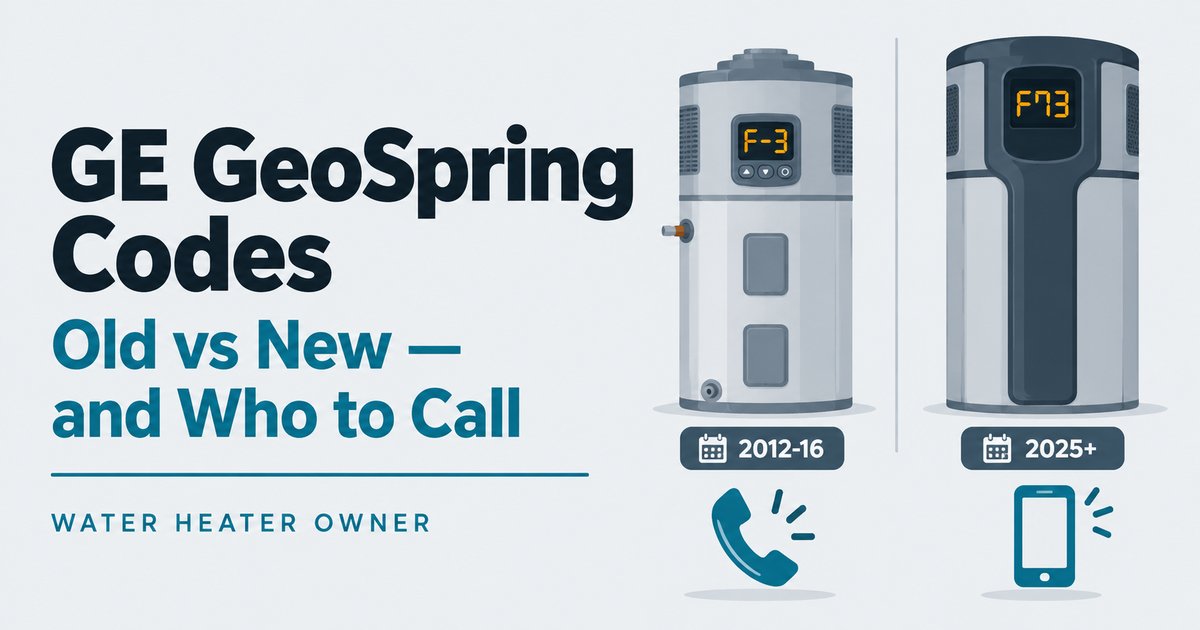
There are two GE GeoSpring water heaters, and they share almost nothing but the name. The original 2012–2016 GeoSpring uses codes like F-C, F-3 and F-11, and service for it runs through Bradford White — not GE. The relaunched 2025+ GE Profile GEOSPRING uses two-digit codes (F10–F96) and is supported by GE Appliances. Figure out which one you own first: the tables below are generation-specific, and so are the phone numbers.
Which GeoSpring do you have?
GE stopped making the original GeoSpring in December 2016, which turned it into an orphan brand overnight. Then in 2025 GE brought the name back as the GE Profile GEOSPRING — a new machine with a new control board, a new code family, and its own support line.
Three quick ways to tell them apart:
- The front jacket. “GE Profile” branding means the 2025+ relaunch. Plain “GE GeoSpring” is the old unit.
- The rating plate. The sticker on the tank has the manufacture date. Made 2016 or earlier: old generation, full stop.
- The code range. The old unit’s fault codes run F-A through F-F, F2, F-3
through F-11, F13 and F15, plus
bAd linE. The new one’s owner’s manual lists two-digit codes from F10 to F96, such asF73,F74andF81.
This matters because many “GeoSpring error code” pages online mash both generations into one list. If a guide lists F-9 and F74 on the same machine, close the tab — the wrong table sends you to a support line that can’t help you.
2012–2016 GeoSpring fault codes
These come from the troubleshooting and fault-code pages of the old GeoSpring owner’s manual. The honest headline first: almost every code on this unit resolves to “call service.” This generation was not designed for owner self-diagnosis — the value of the table is knowing what’s wrong and what to say on the phone, not a DIY fix.
| Code | What it means | Action |
|---|---|---|
F-A | T4 (compressor outlet) temperature not rising | Call service |
F-B | Discharge temperature not stable | Call service |
F-C | Evaporator not frost free | Call service |
F-D | Superheat too low | Call service |
F-E | Discharge temperature above limit | Call service |
F-F | Electronic expansion valve out of range | Call service |
F2 | Tank temperature sensor (T2) failure | Call service |
F-3 | Compressor failure | Call service (see below) |
F-4 | Fan failure | Call service |
F-5 | Evaporator inlet temp sensor (T3a) failure | Call service |
F-6 | Evaporator outlet temp sensor (T3b) failure | Call service |
F-7 | Compressor outlet temp sensor (T4) failure | Call service |
F-8 | Ambient temperature sensor (T5) failure | Call service |
F-9 | Lower heating element failure | Call service |
F-10 | Upper heating element failure | Call service |
F-11 | Dry tank fault | The tank wasn’t filled before power-up — see below |
F13 | Stuck key fault | Call service |
F15 | Data flash (memory) fault | Call service |
bAd linE | Voltage too low at power-up (the unit isn’t getting the 240 VAC it expects) | Turn the power off at the breaker and have the installer (or an electrician) verify the electrical supply |
And three display behaviors that are not what they look like, or that you can act on:
PSon the display is not a fault. It means the unit is running with the ACM module in Power Saver mode. Nothing is broken.- A beeping
F11right after installation means the tank was never filled with water before power-up. Fill it completely, press ENTER to stop the alarm, then POWER with the tank full. The manual warns that powering up without water will damage the electric elements, and that the warranty doesn’t cover damage from running with an empty or partly empty tank — this is the one code where acting fast matters. - To silence the beeping on most errors (the manual’s exceptions are F2,
F11, and
bAd linE), press the UP or DOWN arrow; the display returns to the set temperature while you sort out the service call.
About F-3, the code everyone dreads
F-3 is compressor failure, and if you spend any time on owner forums about this unit, you’ll see it come up a lot — many owners report compressor failures on this platform, often out of warranty. I can’t give you a failure rate; nobody outside GE has that data. What I can tell you is how the math usually lands in those threads: on a 10-plus-year-old tank, owners mostly report that a compressor job (technician, refrigerant work, orphan parts) cost enough that they replaced the unit rather than repair it.
The one consolation, straight from the manual: when a heat-pump system code shows (the manual groups them as F-A through F-8), the unit automatically switches to another available mode so you keep having hot water — and the manual says to contact service immediately. A dead compressor should leave you with a working — if expensive to run — electric water heater. That buys you time to shop instead of taking cold showers, but don’t let the crutch become the plan: you’re paying plain resistance-element rates for every gallon.
Who actually services the old GeoSpring
Not GE. When the product was discontinued, service and support for the 2012–2016 GeoSpring moved to Bradford White: 1-888-443-4394 — the old manual prints that same number as GE’s 1-888-4GE-HEWH line (verify the current number on Bradford White’s official site before calling — support arrangements change). Call with the model and serial number from the rating plate and the exact code on the display.
Most of these units are well past their original coverage, so you’re calling
to arrange paid service or ask about parts, not to file a warranty claim.
Given the “call service” column above,
that call — or a local technician comfortable with heat pump water heaters —
is the realistic path for anything beyond F-11 and bAd linE.
2025+ GE Profile GEOSPRING codes
The relaunched unit is a different story. Its owner’s manual (GE 49-6000330) lists fault codes from F10 to F96; most of them say “Call service,” but several are meant to be owner-fixable, and GE says so directly — if a code doesn’t clear or another appears, that’s when you call an installer, plumber, or GE. These are the ones with an owner action:
| Code | What it means | Action |
|---|---|---|
F61 | Tank water too hot | Should self-correct |
F62 | Incoming water too hot | Reduce pre-heating of the inlet water, or call service |
F73 | Condensate drain pan port clogged | Clear the condensate drain obstruction (owner’s manual has the steps) |
F74 | Dirty air filter | Clean the filter. GE’s note: if the code returns after cleaning, a refrigerant leak is likely — that’s a service call |
F75 | Dry tank fault | Confirm the tank is full of water |
F78 | Leak sensor detects water | If water is pooled at the base or near the wiring, switch off the breaker first (don’t step in water to reach the panel). Then find the leak; reset the shut-off valve if equipped, otherwise call a plumber |
F81 | Leak sensor battery low | Replace the leak sensor battery |
F96 | CTA module disconnected or battery low | Reconnect the module or replace its battery |
Support for this generation is GE Appliances: 1-800-943-8186 (again, verify on geappliances.com before calling).
Two of these deserve a flag. F73 is the same pain every hybrid owner eventually meets — a clogged condensate path — and the fix is the same regardless of brand; the full walkthrough is in the condensate drain guide. F78 is worth taking seriously even when it’s a false alarm: water where the sensor lives means either a real leak or condensate going where it shouldn’t — the leaking-underneath guide covers how to tell which.
The two problems both generations share
For all their differences, both GeoSprings are heat pump water heaters, and they fail in the two ways all hybrids do:
- Condensate. The old unit’s manual lists “condensate drain clogged” as the cause of water dripping outside the unit; the new one gives it a dedicated code (F73). A heat pump pulls moisture from the air every time it runs; that water has to go somewhere. Here’s how the drain works and how to clear it.
- The air filter. The old unit has a filter light; the new one throws F74. A clogged filter starves the evaporator of airflow, and on the new unit a recurring F74 after cleaning is GE’s tell for a refrigerant leak. Cleaning the filter takes ten minutes.
If your code isn’t GeoSpring-shaped at all — A-codes, text messages — the error codes by brand cheat sheet routes every major manufacturer.
FAQ
Is my old GeoSpring worth fixing? Depends on the code. Elements and sensors are ordinary technician repairs. For F-3 (compressor), the pattern in owner forums is consistent: on a unit this old, many people put the repair money toward a new hybrid instead — while running the old tank in electric mode until the replacement arrives. Get a quote before deciding; just don’t be surprised if it’s replacement-shaped.
Can I still get parts for the 2012–2016 GeoSpring? Parts and service questions go through Bradford White (1-888-443-4394 — verify the number on their site). Availability for a discontinued platform is case-by-case — call with your model and serial number ready. Generic parts like anode rods are easier; platform components like the compressor and control board are the hard ones.
Does the new GeoSpring have the same compressor problem? Nobody honestly knows yet. The 2025+ unit is a new machine that hasn’t been in the field long enough for reliability patterns to show. The old platform’s compressor complaints are well documented in owner forums, but nothing about the relaunch says the new unit inherits them — treat it as an open question, not a verdict either way.

Dan Mercer — Dan Mercer is the pen name of Water Heater Owner’s editor. I’m not a licensed plumber or electrician, and I don’t sell or install water heaters. Every guide here starts from the manufacturers’ manuals and technical bulletins, is cross-checked against what owners consistently report, and says which is which — including what you can safely check yourself and when it’s a job for a licensed plumber or electrician.